
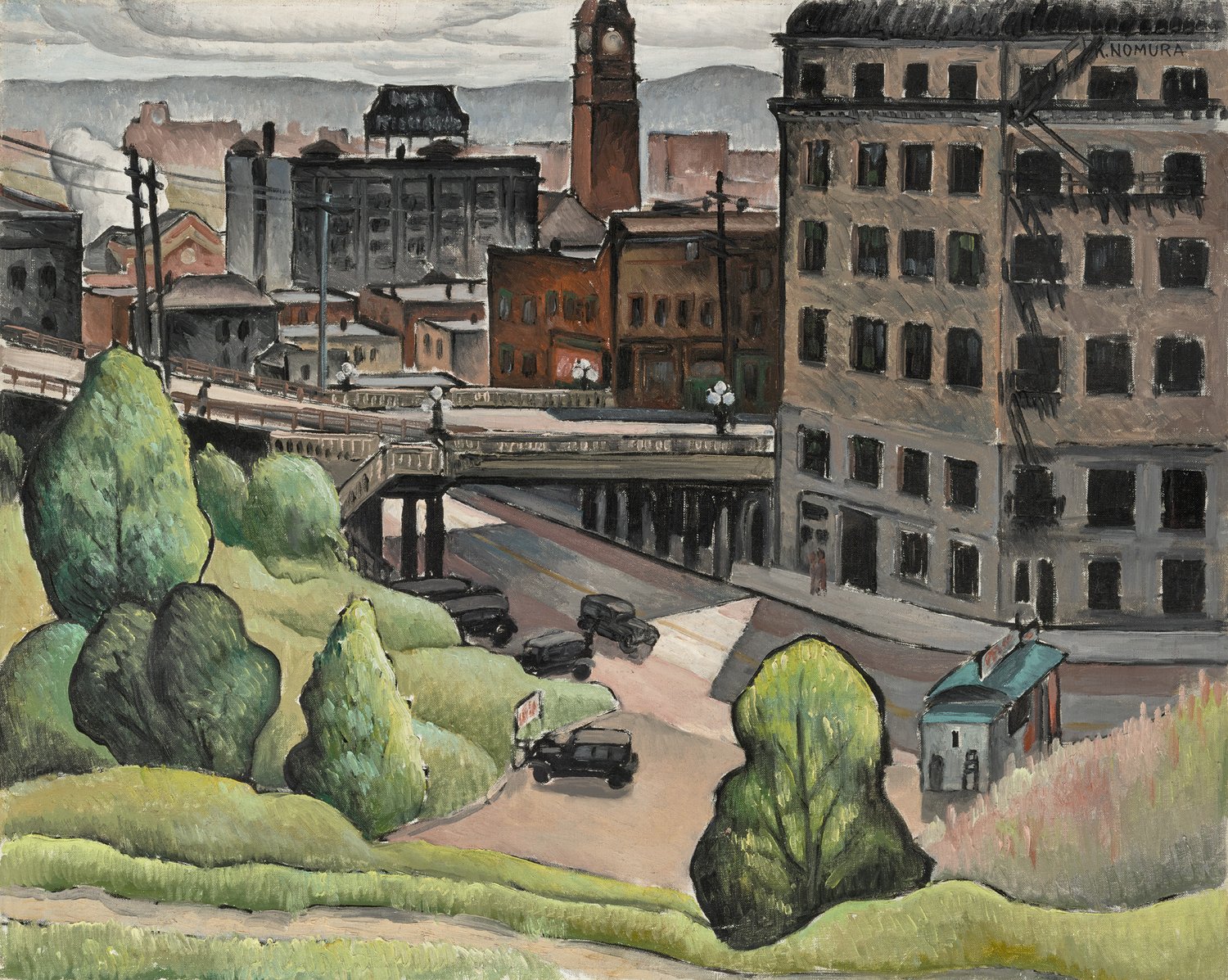
The exhibition Side By Side: Nihonmachi Scenes by Tokita, Nomura, and Fujii, now on view at the Wing Luke Museum, offers a unique look at Seattle’s Nihonmachi, or Japantown, in the 1930s through the work of notable Issei artists Kamekichi Tokita (1897–1948), Kenjiro Nomura (1896–1956), and Takuichi Fujii (1891–1964).
Curator Barbara Johns has authored monographs on each of the featured artists, and this exhibition is the largest-ever assembly of their work together, showcasing artworks created at the height of their artistic recognition.
After leading the University of Washington Press staff on a tour, Johns shared more about the exhibition and artists over email. Read our Q&A to learn about the recovery of Tokita, Nomura, and Fujii’s work, how the artists were shaped by Seattle’s Nihonmachi, and how their legacies continue to impact the community today.
What were some of the connections you wanted to highlight among Tokita, Fujii, and Nomura when curating this exhibition?
First, the artists were friends who often painted alongside one another. It’s interesting to look for similarities and differences; each displays individual artistic inclinations. Another connection is their relationship to place. They painted the neighborhood in which they lived and worked. These are sites of daily familiarity, pictured from the pedestrian’s viewpoint. Many offer paths into the scene, and Tokita’s work, especially, shows the quotidian details and textures of the neighborhood’s modest buildings.
On Sundays, their days off from work, the artists sometimes ventured farther afield to the working waterfront of Fishermen’s Terminal or the West Seattle Bridge, where they sought challenging perspectives of structure. Wherever they painted, they rendered the Northwest as place in their characterization of its changing skies and diffuse light.

How did Seattle’s Nihonmachi, or Japantown, shape the work of these artists? What role do you think the community plays in understanding their art today?
I’ve mentioned the specificity of place and their pedestrian’s perspective. Their viewpoint conveys a sense of belonging, a place they called home. The scenes farther from Nihonmachi similarly trace routes of familiarity and extend the field of belonging.
In organizing the exhibition, I thought it important to include voices besides mine, individuals with personal connections to Nihonmachi. Binko Chiong-Bisbee, third-generation Japanese American on her mother’s side and co-owner of Kobo at Higo, is one of those. In her text for the exhibition, she describes far better than I can the relationship of the paintings and the community today in a fervent call to action:
“These paintings show how far Japantown extended in the 1930s. Japanese businesses were located as far west as Pioneer Square and then later eastward on Yesler and Jackson Streets. The Nihonmachi neighborhood encompassed much more area than it does today. It was once a bustling, active place with over 8,000 Japanese Americans running restaurants, hotels, bookstores, grocery stores, cafes, florists, and numerous shops selling a variety of goods in the 1930s and 1940s.
“The Nihonmachi of today is much quieter and smaller, but there is a collective group of business and property owners, residents, and community members who are working together to preserve Nihonmachi as an important cultural asset in Seattle. It takes effort to make sure that this neighborhood does not disappear, and our hope is to pass along to the next generation the history and stories of those who came before us. . . .
“The National Trust for Historic Preservation named the Seattle Chinatown–International District (CID) to its 2023 list of ‘America’s 11 Most Endangered Historic Places’—marking Washington State’s first inclusion on the list since the trust was established in 1988. Although this is a sad distinction for our neighborhood, it is a positive step to have this acknowledged and recognized. It will take a concerted effort to sustain and safeguard our community from gentrification and other economic pressures to develop this area. Imagine Seattle without this special neighborhood that we call home.”
Side by Side features work from the 1930s, a period of flourishing and widespread recognition for these artists who, like many other Japanese Americans, struggled to rebuild their lives after mass incarceration during World War II. Can you walk us through how the stories of these artists and their work have been brought back into focus?
A long story as briefly as possible! The artist George Tsutakawa knew the older painters and kept their names alive. His University of Washington colleague the art historian Martha Kingsbury and his daughter Mayumi Tsutakawa brought renewed attention to the artists in the 1970s and early 1980s. David Martin, Kazuko Nakane, and others would later address their work. My own involvement began during the 1980s when I worked at the Seattle Art Museum and was drawn to Nomura’s and Tokita’s paintings in the collection.
During this time, while also managing an Asian American artists project for the Smithsonian’s Archives of American Art, I met Tokita’s eldest son, Shokichi, and helped him donate his father’s papers to the archives. Those papers included a wartime diary, which twenty-five years later would become the impetus for my book about Tokita. I later met Nomura’s son, George, and in extended conversations with him and his wife before his death made plans for a book. My introduction to Fujii’s family was serendipitous [see below]. This research has been exceptionally gratifying recovery work, and I’m grateful to the artists’ families for entrusting me with their stories.

The exhibition also includes the illustrated diary of Takuichi Fujii from the Puyallup and Minidoka incarceration camps, reproduced in part in your book The Hope of Another Spring. What can you share about this remarkable document and its recovery?
Fujii was the least known of the three artists and seemingly disappeared after the war; he was even reported as having returned to Japan. (In reality, he settled in Chicago with his family and died in 1964.) I was beginning a dissertation on these artists when I was unexpectedly introduced online to his grandson, Sandy Kita, who is a scholar of Japanese art. He had just finished translating his grandfather’s wartime diary. When I met him and his wife at their home on the East Coast, they brought out two boxes that contained about 150 watercolors and an illustrated diary from the war years. These had been stored by three generations of the family. As a curator, I immediately proposed an exhibition of this hidden treasure of artwork! Sandy gave me a photocopy of the diary in translation, and we agreed to continue the discussion.
Back in Seattle, I showed the diary to two of my mentors in Japanese American studies, the historian Roger Daniels and Tom Ikeda, founding director of Denshō. I didn’t yet have the experience to appreciate its singularity. They highlighted its Issei (first-generation) perspective and the portrayal of the full range of camp life in granular detail, from the forced removal until Fujii’s eviction from Minidoka three and a half year later. In his foreword to my book, Roger calls the diary “the most remarkable document created by a Japanese American prisoner during the wartime incarceration.”
What do you hope visitors take away from the exhibition?
I hope people come away with an appreciation of the artistic achievement of these immigrant-generation Japanese American artists—and with it, a deepened appreciation of the multicultural wealth of American art. I hope their artwork demonstrates the value of preserving and telling our collective community’s stories.
The exhibition includes documentary photographs and objects representing Seattle’s vibrant cultural and entrepreneurial Japanese American community before World War II, and I hope visitors take away new insights about Nihonmachi and the importance of preserving and protecting what remains.
Side by Side: Nihonmachi Scenes by Tokita, Nomura, and Fujii is on view in the George Tsutakawa Gallery at Wing Luke Museum through May 11, 2025.
Barbara Johns, PhD, is a Seattle-based art historian and curator. She is the author of Signs of Home: The Paintings and Wartime Diary of Kamekichi Tokita, The Hope of Another Spring: Takuichi Fujii, Artist and Wartime Witness, and Kenjiro Nomura, American Modernist: An Issei Artist’s Journey. Johns currently serves on the University of Washington Press Advancement Board.
Related Books


