
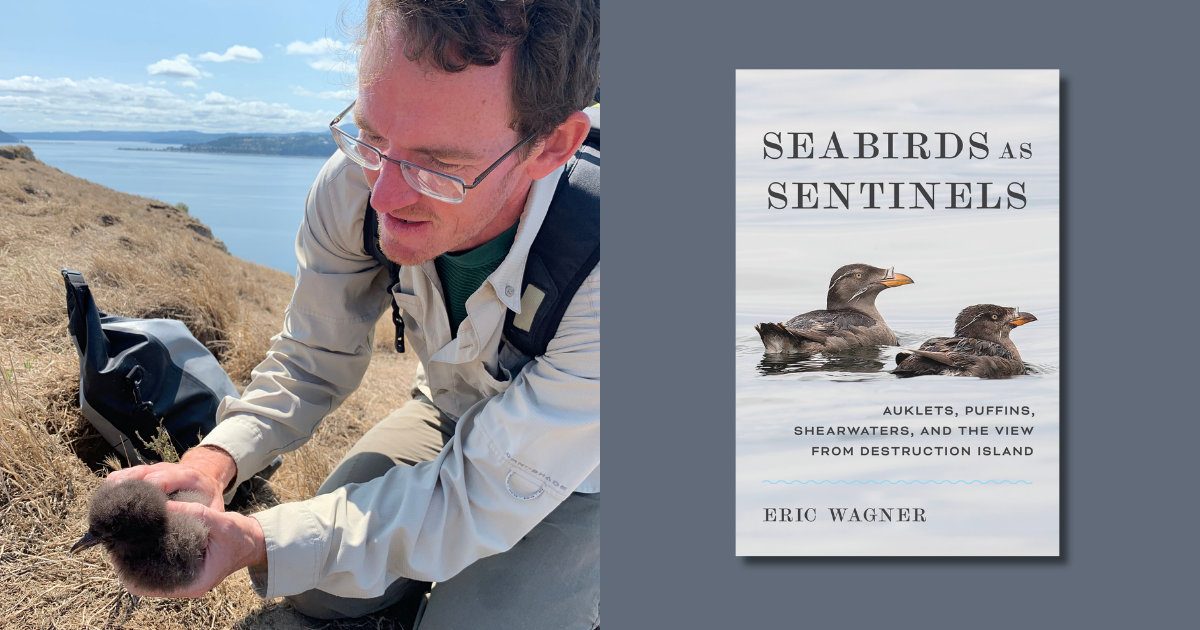
In Seabirds as Sentinels: Auklets, Puffins, Shearwaters, and the View from Destruction Island, author Eric Wagner joins a team of scientists who have been tracking the lives of seabirds to gauge the effects of climate change in the North Pacific. Sometimes called the Blue Serengeti, this region is one of the most productive ecosystems on Earth, yet its waters are changing in unprecedented ways. Here, Eric shares more about his time tracking seabirds off the coasts of Washington and Vancouver Island, and how deep observation reveals both wonder and urgency.
You spent extended time with researchers on Destruction Island, Protection Island, and Triangle Island, where thousands of seabirds live. What was it like to step into that world? Was there a moment early on when you realized, “This is the story I want to tell?”
Eric Wagner: Probably the moment I realized how much I wanted to spend a lot of time with the birds and their many stories was on my second visit to Destruction Island way back in mid-August of 2017. Scott [Pearson, a biologist with the Washington Department of Fish and Wildlife] and Peter [Hodum, a biology professor from the University of Puget Sound] had let me join them even though I had no compelling reason, since I had been out to Destruction just a couple of weeks before to write a magazine article about their auklet work. By August the auklets were largely finished breeding, and Scott and Peter were focused on the island’s tufted puffins. They said I could help count puffins and stashed me atop a bluff with a view of the puffins’ small colony and the ocean beyond; they then went to a lower spot where they could take pictures of puffins around the individual burrows.


For more than three hours I sat alone while the sun set, counting puffins every fifteen minutes as they rafted on the water, while thousands of other birds went about their business. The wind was strong and cold and I had to put on all my layers, but for me the moment was transporting. Sitting on an exposed perch while the sun set, surrounded by the sounds of ocean and gulls and the occasional oystercatcher, I felt removed from the rest of the world. But just a couple of miles behind me was the mainland Olympic Peninsula and all the rest of Washington. That juxtaposition was kind of shocking—to be so far from everything, but also not so far at all, with the birds as a draw. To stand on one side of the island and look all the way across the whole of the Pacific and see highway 101 on the other. I knew then that I wanted to spend a while exploring that.
Can you give an overview of why the North Pacific supports so much life, as well as some of the changes that we’re seeing on its shores?
EW: Summers on the northeast Pacific—because, somewhat counterintuitively, those of us on the west coast of North America live on the eastern edge of the Pacific—are highly productive primarily because of coastal upwelling—a wind-driven process by which cold, nutrient-rich waters are hauled up from the deep so that all their nutrients are available to organisms that live closer to the sea’s surface. Coastal upwelling supports phytoplankton, which in turn support zooplankton and smaller forage fish, which in turn support larger fish and birds and whales and other marine mammals and humans and all the rest. That pattern has been disrupted in the past by phenomena like El Niños, but in recent years the Pacific has been getting warmer and warmer, such that expected processes no longer occur or are significantly weakened. That’s why people will see news about starving grey whales, wrecks of seabirds, or other mass mortality events.

You point out how in ecology an apparent abundance of life can mask fragility. For instance, on Triangle Island, you were among one of the world’s largest seabird breeding colonies, yet sustained research there reveals a population in sharp decline. Can you share examples of how long-term attention leads to a better understanding of species at risk?
EW: One of the things about seabirds is that they are generally hard to count. Even when they come to land, that land may be an island many miles out at sea, and on that island auklets and puffins and shearwaters and others may nest in deep burrows that are difficult to see into. Biologists have had to do the best they can to assess populations of different species in hard-to-reach places. Some inference or informed speculation has necessarily been in order, but sometimes those sorts of spot-check approaches can lead to a false sense of assurance.
Before we can know whether [seabird] numbers are rising or stable or falling, before we can try to understand the reasons why, before we can begin, perhaps, to do something to arrest those declines, before we can beseech on the birds’ behalf, we first have to pay attention to them.
Eric Wagner, from “Seabirds as Sentinels”
You see a lot of birds, you assume things are fine. Maybe those birds aren’t doing so well, though, like the murres at Triangle, which rarely raise chicks because of gull predation pressure, among other things. These are the sorts of things you wouldn’t be able to tell if you came to an island once or twice and simply counted every murre you saw, because you would see thousands! Even if you saw that none of the pairs had eggs, you might just chalk it up to a bad year, rather than bad year after bad year after bad year. And so to really know how something is doing demands a kind of intimate attention and patience and care, which we would all offer if we could, but the logistics are sometimes too tricky.
There are intimate, almost hidden glimpses in the book, like watching auklets in their burrows or tracking seabirds out at sea. Did your own relationship with these birds change over time as you observed them more closely?
EW: Oh, definitely. One of the gifts of being able to visit the auklets over the course of several years was starting to witness subtle differences among the seasons or see them in different contexts—on the island, out at sea, in Puget Sound, and so on. You get a fuller picture of the species, start to see them more as individuals. One of my favorite things was to sit on the island at night and just let the auklets wander around me, like I was a tree stump. They might have been a little hesitant at first, but eventually they seemed to grow accustomed to my presence and would carry on in their way. It wasn’t a feeling of trust—they should never trust me and never did—so much as letting me fade into irrelevance. I loved it.

In the book, you’re translating both the science and the day-to-day lives of the people doing it. As a scientist yourself, was there anything that surprised you about the research you write about?
EW: That it still happens? Especially these days. There isn’t a ton of money or interest, necessarily, in just straight monitoring work. So to watch Scott, Peter, Tom [Good, a biologist with the National Oceanic and Atmospheric Association], and others do the same things every year, and draw information from those procedures, became a ritual of a sort. There were side projects, of course, but I liked being able to participate in that sense of sameness, given the huge changes into which their routines were providing insight.
You’re bringing readers into a place most of us will never go, and into a kind of scientific work we rarely see. What do you hope sticks with someone after they finish the book—not only about seabirds, but about how we pay attention to the natural world?
EW: I would hope people would come away appreciating an ethic of observation. And an anticipation of the richness that can come from watching something closely and learning its rhythms. It can be tough these days to love the more-than-human world. So much seems to be going wrong with it—fewer birds, for instance, or more general destruction, more heedless expansion, and so on. It’s tough for me, anyway. But better to look than not. I remember reading an essay by Terry Tempest Williams after the Deepwater Horizon spill in 2010 where she had a line, “To look is not a passive act.” (She’s said versions of that in other places.) The first time I read it, I felt this little flare of dissatisfaction. Looking was not enough for me, was never going to be enough. But I had missed her point. There are so many pressures and incentives and distractions trying to get you not to look, to look away. It took me longer than I’d care to admit to understand that what she was saying was that looking is the vital first step. And then you start to see some of the bright spots, too, of recoveries, or hidden capabilities.


Eric Wagner is a staff writer with the Puget Sound Institute at University of Washington, Tacoma. He is author of After the Blast: The Ecological Recovery of Mount St. Helens and Penguins in the Desert and wrote the text for Once and Future River: Reclaiming the Duwamish.
Related Books


