
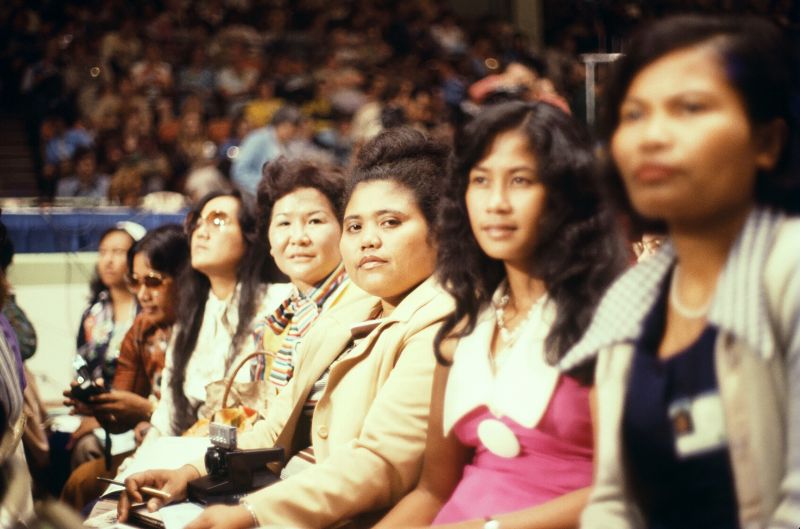
In November 1977, over twenty thousand participants, mostly women, gathered in Houston for the first and only US National Women’s Conference, funded by the federal government with the goal of creating a national women’s agenda. In Moving Mountains, Judy Tzu-Chun Wu and Adrienne A. Winans center the more than eighty Asian American and Pacific Islander delegates who politically mobilized around women’s rights and other issues to transform their communities and their status in the nation-state.
Foregrounding figures like Congresswoman Patsy Takemoto Mink and poet Mitsuye Yamada, Wu and Winans position AA and PI women as central actors in the era’s feminist politics, engaging with, and at times resisting, state institutions to forge paths toward racial and gender justice.
The following is an excerpt from the book about Patsy Mink—the only Asian American woman among national and international political leaders to deliver a keynote speech at the conference—and how AA and PI women built a collective political agenda and fostered cross-racial solidarity.
A Rare Achievement
The Asian American and Pacific Islander participants of the National Women’s Conference [NWC] arrived in Houston with a sense of excitement. They were experiencing a historic gathering and had been charged with creating a national agenda of women’s issues. The political energy that they had channeled into the state and territorial meetings carried over into Houston. Even before the conference started, they reached out to one another to learn about each other’s issues to create a collective agenda. Political differences existed between these women, but those who searched for commonality were inspired by the efforts of other women of color. Together they sought to rewrite and amplify the minority women’s plank—one of twenty-seven that would be discussed and voted on at the conference. By creating a collective statement about the needs of Asian Pacific American women, as their caucus was named, Asian American and Pacific Islander women would stand in solidarity with African American, American Indian and Native Alaskan, and Chicana and Latina women.


Asian American and Pacific Islander women’s involvement with the National Women’s Conference can be categorized into four types of participation. First, Patsy Takemoto Mink, the most recognizable national political figure, gave one of the keynote speeches at the conference. Second, a select few Asian American women were invited to serve on the national commission that organized International Women’s Year. Third, more than seventy women participated as delegates, attending workshops, negotiating with one another, and voting on planks. Some emerged informally as leaders to connect and create commonality among Asian American and Pacific Islander delegates. Some also presented planks or spoke on issues for the entire NWC gathering. Finally, others attended as observers. They did not have an official role and could not vote, but they were drawn to the promise of the national gathering and eager to witness and participate in whatever capacity they could.
The NWC offered a platform for national dialogue, and its impact resonated for years. The Asian Pacific women’s statement captured the coalescence of collective issues as well as the omission of significant perspectives.
The National Women’s Conference has been interpreted by some as the beginning of the end, with the growing ascendancy of antifeminists that would culminate with the election of Ronald Reagan in 1980 and the Republican dominance of that decade. This reading of the late 1970s resonates in some ways with Asian American history. In 1977 the protest to save the I-Hotel in San Francisco ended abruptly and violently as city officials forcibly evicted the tenants. The hotel offered low-income housing for Filipino elders and a base for radical activism in the Chinatown/Manilatown neighborhood. A year later the Supreme Court ruled against affirmative action in University of California v. Bakke. Despite these setbacks, a throughline of persistent and growing advocacy among Asian American and Pacific Islander women runs through Houston and the National Women’s Conference. Some of the same political advocates who gained national visibility at the NWC became spokespeople in convenings and publications related to Asian Pacific Americans and civil rights in the late 1970s. In addition, the Republic of the Marshall Islands (1979), the Federated States of Micronesia (1979) and the Republic of Palau (1981) were all established in the years immediately after the NWC.

The NWC offered a platform for national dialogue, and its impact resonated for years. The Asian Pacific women’s statement captured the coalescence of collective issues as well as the omission of significant perspectives. Nevertheless, the opportunity to foster personal connections and create political networks had a lasting impact. The collective agenda articulated at the NWC inspired ongoing conversations and political mobilizations at the local, regional, national, and international levels for decades.
Patsy Mink, one of the legislative cocreators of the NWC, spoke to the gathering of twenty thousand attendees on Saturday evening, 19 November 1977. Mink, the first woman of color in Congress, had completed six terms in the House of Representatives from 1965 to 1977, but lost her senatorial campaign during the bicentennial year. Due to Mink’s sponsorship and defense of Title IX as well as her leadership in proposing legislation for federally funded childcare and early childhood education, she was a widely recognized advocate for women’s issues. Following her electoral loss, feminist political leaders lobbied for Mink to receive an appointment under President Jimmy Carter. Known for her leadership in protecting the environment as well as in advancing gender equity, Mink became assistant secretary of state for oceans and international environmental and scientific affairs.
. . . .
Mink’s speech in Houston reflected on both the collective and personal significance of the gathering. She commented, “I believe there is a cross-section of America present here tonight and that your deliberations will reflect the major forces of change and reform in our society to the end that women shall be finally equal under the law.” She noted that their efforts followed “two hundred years” of shaping “this nation, to give its institutions direction and purpose. . . . Each step of the way towards the building of our democracy has been hard fought.” Mink acknowledged the importance of Black and other racialized groups in paving the way for other minoritized groups and recognized the National Women’s Conference as “the culmination of [her] life’s work—no small part of it being motivated by the intense wish that somehow all the personal affronts, put-downs, and outright discriminations which I endured to make my own way as a human being can be spared my daughter and yours.”
For [Patsy] Mink, the political experiment of the National Women’s Conference defined the essence of a democratic society that the United States proclaimed itself to be.
In comparing the women’s rights struggle to other minoritized peoples’ efforts to achieve equality, Mink emphasized that women were in fact the majority, not a numerical minority. As she noted, “This meeting of women is unique in that unlike the true minorities, you possess the numerical majority to make this country whatever you choose.” She went on, “Our destiny is in our own creation. Do we want change? How shall we achieve it? How do we mobilize this numerical majority of women to act?” Mink’s emphasis on women’s self-determination is a significant insight that she shared in many of her speeches. If women of diverse backgrounds could develop a common political purpose, they had the numerical potential in a democratic society to choose their own destiny. Mink recognized the structural and societal reasons why it was not as simple as women defining their own agendas. But, unlike numerical minorities, women as a population category had a demographic advantage. If women did not speak up for themselves, then “silence is acquiescence to our own derogation.”

To encourage women to work toward a common purpose, Mink addressed the political divide between conservative women who sought to “save the home” through a defense of traditional gender roles and those who “pushed [their] way into the centers of business, of science, of government, of politics.” Rather than accept the political cleavage, Mink encouraged the attendees to recognize that “homemakers, too
. . . have struggled separately for the most part of our entire adult lives to breathe life into equality.” Similarly, those who seek to break gender barriers are not antifamily. In fact, as Mink pointed out in her expressed commitment to spare her daughter and others from the pain of gender discrimination, “women who have lived hardships . . . out of their personal experience are now committed to finding solutions for their children’s future security and happiness.”
For Mink, the political experiment of the National Women’s Conference defined the essence of a democratic society that the United States proclaimed itself to be. She charged the group to consider: “No matter how vigorously we may disagree and debate procedures and strategies, the bottom line of this Conference must be a serious attempt to provoke meaningful change so that American women of the future can be assured justice, equal protection under the law, and full participation in their own government as proclaimed by our Constitution.” Mink’s presence and words were particularly inspirational to other Asian American women. Jane Yamashiro, head of the Alaska delegation (though she was from Hawai‘i), as well as April West from Washington state, both reflected how meaningful it was to see and hear an Asian American woman like Mink featured as a keynote speaker for the National Women’s Conference.
It is noteworthy that the chronology of women’s history that was published after the conference in The Spirit of Houston misdated Mink’s congressional terms. She is identified as the “first and only Asian woman elected to Congress” in 1970, the same year that Bella Abzug was elected. The chronology lists Shirley Chisholm as the first African American woman elected to Congress in 1969. Mink, actually elected in 1964, was the first woman of color in Congress.

Judy Tzu-Chun Wu is Chancellor’s Professor of the Departments of History and Asian American Studies at the University of California, Irvine, where she also serves as an associate dean in the School of Humanities and faculty director of the Humanities Center. She is coauthor of Fierce and Fearless: Patsy Takemoto Mink, First Woman of Color in Congress.


