
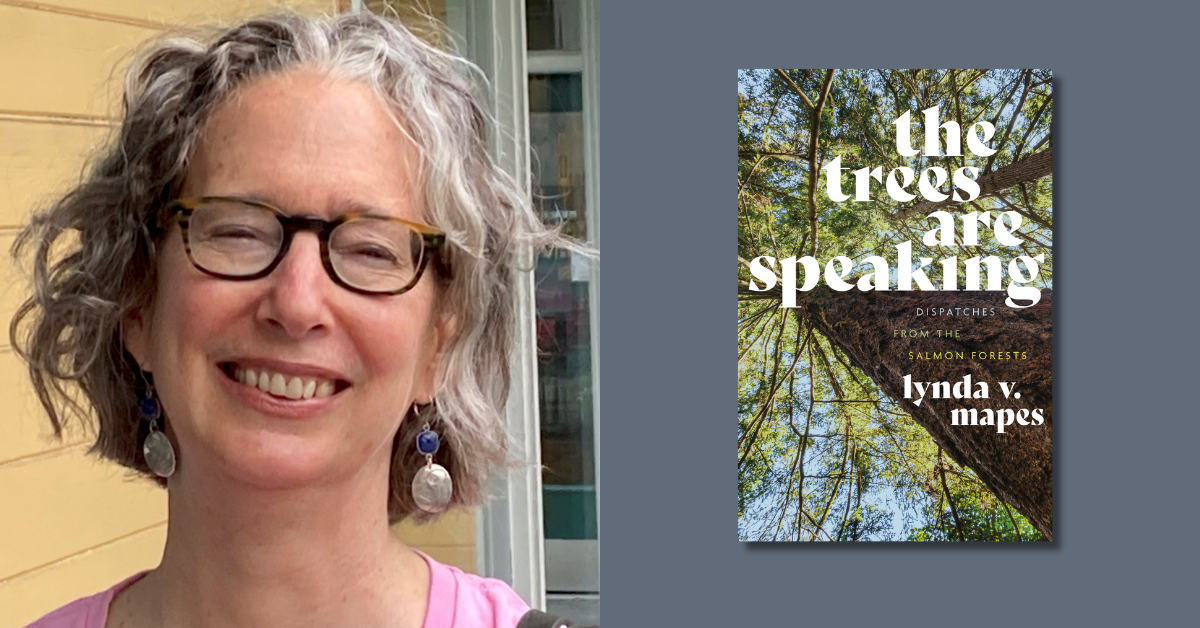
“Ours is a time of reckoning for our forests,” writes Lynda V. Mapes in The Trees Are Speaking: Dispatches from the Salmon Forests. Available now, the book is a call to rethink our relationship with forests that is “certain to leave readers with a desire to act” (Booklist).

An award-winning journalist and keen observer of the natural world, Mapes brings her on-the-ground investigative skills to bear as she tells the story of our imperiled old-growth forests. Journeying from coast to coast, she connects the present and future of Pacific Northwest forests to the hard-logged legacy forests of the northeastern United States. Her sources range from voices across Indian Country to the most eminent forest ecology experts. She bushwhacks through old-growth understory, climbs up a 400-year-old Douglas fir, and explores pristine salmon forests on Nootka Island untouched for centuries.
The Trees Are Speaking brings readers to the front lines of these forests and introduces people as diverse as the forest communities themselves—individuals fighting to save irreplaceable old-growth and the unique ecosystems that these ancient trees alone can create.
Excerpted from The Trees Are Speaking: Dispatches from the Salmon Forests
This book began for me as an encounter with the ecology of old-growth forests in the Pacific Northwest—the science of what they are, why they matter, how they work. I explored some of the oldest trees alive, on Vancouver Island in British Columbia, part of the largest temperate rain forest on Earth, and especially the salmon forests. The term is used by author and environmental activist David Suzuki, among others, to describe the swath of temperate rain forest nurtured by the largest animal migration in the North Pacific: salmon coming home from the ocean to their freshwater streambeds, where they were born.
The influence of salmon on these forests is so profound, John Reynolds of Simon Fraser University learned, that the signal of the nutrition they bring back from the sea can be seen in a surge of canopy greenness visible from space.
Lynda V. Mapes
Here is an interconnected abundance so intimately interdependent—the forests laced with freshwater streams are full of salmon, and the salmon are nurtured by the forests. The beautiful term salmon forest is not a mystical concept but a scientific truth, documented by decades of research. The influence of salmon on these forests is so profound, John Reynolds of Simon Fraser University learned1, that the signal of the nutrition they bring back from the sea can be seen in a surge of canopy greenness visible from space. Reynolds worked with his collaborators to examine streamside vegetation in fifty watersheds in the Great Bear Rainforest of British Columbia and found the plant community along salmon streams is dominated by species such as salmonberry that indicate rich soils. Salmon, this research showed, influence not only the abundance but the community structure of the streams and forests where they are born and where they return and die. In death, they are transformed into the flesh of bears, the succulence of salmonberries, and the enormity of trees surging with nutrition from salmon.

These forests are found amid the old-growth temperate rain forests on the western slopes of the mountains from Southeast Alaska to British Columbia through Washington, Oregon, and Northern California. Steeped in as much as twelve to fourteen feet of rainfall, these forests thrive in moderate temperatures in low-elevation valleys. This is the land of the light sweater, the layers peeled but never put too far away; it doesn’t freeze here often, nor do summer temperatures often rise above 80 degrees. Apart from the wetness and their mild climate, it is the sheer botanical beneficence of these old-growth temperate forests that sets them apart. These are forests with trees so massive and so rich with vegetation, they are among the most carbon-dense forests on Earth. The trees are plastered with even more green life growing atop them—mosses and lichens drape and festoon and coat tree trunks and branches, and fern gardens sprout and cascade from treetop to ground.
To be in an old-growth forest is to feel cloaked, as if walking in a living terrarium, padding around a soft kingdom of green. Sitka spruce, western hemlock, and cedar interspersed with bigleaf maples garlanded with ferns and swags of moss are the signatures of these forests. Some of the conifers can persist to great age: Douglas fir to five hundred, eight hundred, and even a thousand years, and cedar even longer. These trees can tower as much as 250 feet in height and grow to 60 feet around. These are forests with dead and downed logs everywhere. Communities of mosses, tree seedlings, and fungi thrive in this dead wood, which is more alive than the living trees next to it, for sheer biomass. Small mammals, amphibians, birds, and bears all make homes in the cavities of these dead and decaying trees. For old-growth forests are places where everything is alive, even things that supposedly are not—from the rocks cushioned with lichen and moss to the snags and logs teeming with new life.

Lynda V. Mapes covers environmental and Indigenous issues for the Seattle Times. She is author of six books, including most recently Orca: Shared Waters, Shared Home, winner of the 2021 National Outdoor Book Award and the 2021 Washington State Book Award for nonfiction. Her journalism has earned numerous prestigious awards, including the international 2019 and 2012 Kavli gold award for science journalism from the American Association for the Advancement of Science. She is also an associate of the Harvard Forest of Harvard University, in Petersham, MA.
- John Reynold’s work on seeing the influence of salmon in the plant communities of salmon streams and even the greenness of the trees is explored by Christopher J. Brown, Brett Parker, Morgan D. Hocking, and John D. Reynolds, “Salmon Abundance and Patterns of Forest Greenness As Measured by Satellite Imagery,” Science of the Total Environment 725 (2020): 138448; and Morgan D. Hocking and John D. Reynolds, “Impacts of Salmon on Riparian Plant Diversity,” Science 331 (2011). ↩︎
Related Books


