
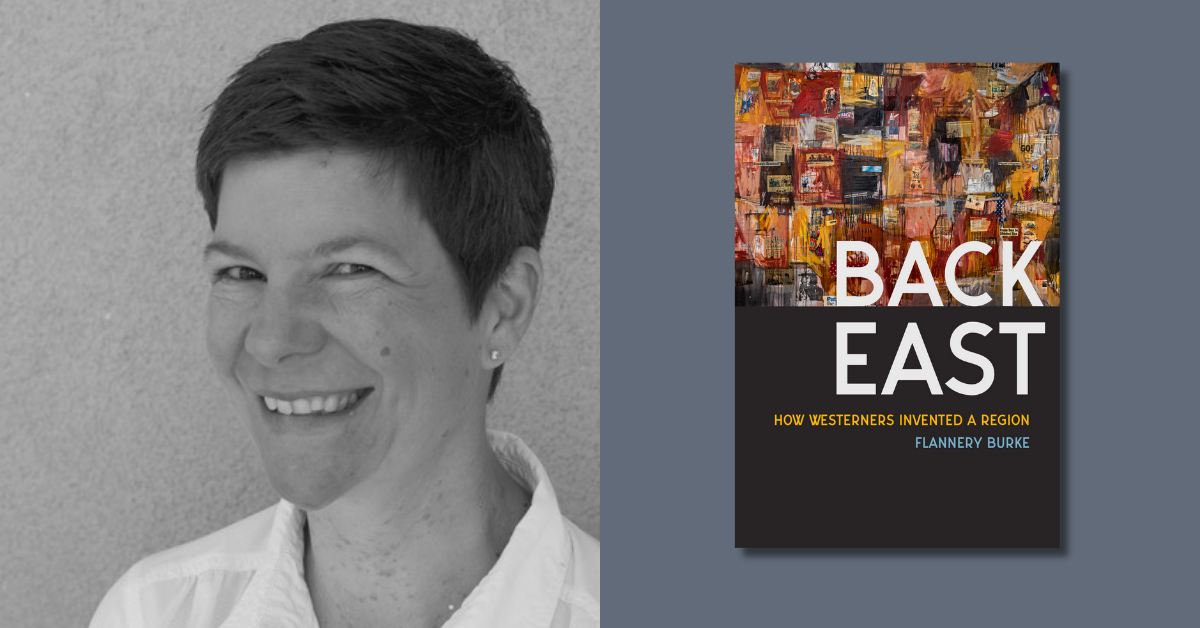
The idea of the “frontier” has long dominated US history and regional identity. But in her book Back East: How Westerners Invented a Region, Flannery Burke offers a different take on American historiography. Rather than examining how Easterners imagined the American West, Burke explores how Westerners constructed their own vision of the American East.
The nation’s cultural landscape comes into sharper focus if we take a moment to look through westerners’ eyes. In the Q&A below, Burke delves into the motivations behind her research, what the “East” has meant to westerners, and why reexamining these narratives matters today.
Could you share a bit about your background and what drew you to the questions of region, identity, and narrative that shape Back East?
I grew up in Santa Fe, New Mexico, where I did a lot of reading and a lot of watching television and a lot of trying to please my elders. My mother’s family was from the area around Las Vegas, New Mexico, and my dad grew up on a family farm in northeastern Kansas. Almost all of their ancestors came from somewhere outside the United States directly to the places that my parents grew up. Like a lot of people in New Mexico, my mom could also trace some of her ancestry southward to Mexico and to Spanish conquest of the Americas. That meant I didn’t have family memories of ancestors slowly moving from the eastern United States to the western United States. I didn’t grow up hearing stories of my ancestors’ urban immigrant grit either—none of them lived in a tenement or worked in a sweatshop in New York City or Chicago. Little in my day-to-day life or my family background squared with what I was reading and seeing on TV or even what I was learning in school about the history of the United States.
But I had that strong desire to please! So I developed this fantasy about a place that everyone from my grandparents in Kansas to my high school college counselor called “back East.” People there moved fast and dressed well. They worked in tall, elegant brick buildings examining ticker tapes. They read in graceful libraries with big leather chairs or outside, under maple trees. They made decisions about building roads and starting wars. Many had worked their way up from the tenements and the sweat shops. I was a little hazy on the geography—sometimes back East was in Nebraska! Still, I got the distinct impression that I was supposed to go back East to be successful. Then I went to college in the suburbs of Philadelphia and was enormously homesick. Only then did I realize how rich my education in New Mexico had been. There, I hiked outdoors. I tracked my water use. I learned from Pueblo and Diné people the long, complicated history of the place I called home. I felt that I had made a huge mistake by leaving the West, but I couldn’t admit it. I had invested too much in the fantasy that I had absorbed. Back East is my effort to figure out where that fantasy came from and why it was so powerful.
You explore how the ideas of “out West” and “back East” worked in tandem. How did these regional narratives reinforce one another?
There’s a children’s book by Marjorie Weinman Sharmat that I love called Gila Monsters Meet You at the Airport. In it, a boy leaving New York City frets about his family’s move to the desert Southwest. He’s afraid it will be hot and dry, that everyone will talk too slowly, and he will have to ride a horse to school. In the airport, he meets a boy moving East. This second boy is afraid that the East will be cold and crowded, that gangsters will fool him into thinking they’re nice by wearing flowers in their lapels, and that alligators from the sewers will meet him at the airport. The New Yorker arrives and realizes that the West is not so bad—people play baseball and eat salami sandwiches. Maybe riding a horse would be kind of cool. He resolves to write his friend Seymour back in New York and tell him that he sent the letter by Pony Express. He’s sure that the friend will believe him. “Back East,” he says, in the last line of the book, “they don’t know much about us Westerners.”
Historians of the American West and scholars in American studies have written extensively about the “imagined West.” Most of what they have written has been from the perspective of folks like the protagonist in Gila Monsters: easterners who imagine the West as something it is not. Some of this work debunks easterners’ perceptions. They use taxis. Some show how westerners played on eastern expectations in the tourist and entertainment industries. Really excellent work in this field focuses on instances when eastern and western expectations mirror one another in an infinite reflection of desire and expectation and apprehension. All of this work wrestles explicitly or implicitly with a central myth of the frontier: that westward expansion executed by the individual meant development and prosperity for the nation.
What mainstream media often calls “rural resentment” has roots in back East narratives and does some of the same narrative harm that back East did elsewhere—it covers over a more complicated reality.
Flannery Burke
In Back East, I wanted to see what would happen if the story started in the West. Would the meeting play out differently if westerners were the protagonists? What did westerners realize when they arrived back East? Could western subjects somehow short-circuit that infinite reflection that always seems to lead back to the frontier? The story does play out differently—westerners drew on their western background when they were holding the ticker tape and making the laws and writing the books. They were well-versed in manipulating eastern expectations of the West, and they used that training and expertise when they were in the East to achieve their goals. That made a difference for land and water conservation and for investments in westerners’ education and funding for the arts throughout the second half of the twentieth century. But the infinite reflection held—westerners reinforced the notion that individual success meant national progress, growth, and expansion when they imagined heading back East as the rejoinder to heading out West. As I write in the book, “Westerners who trod the frontier in reverse only wore its groove deeper.”
In your research, what periods in US history stood out to you as moments when regionalist thinking took on special urgency or influence?
For a long time, I felt like every footnote I wrote included the dates 1946 or 1947. I really struggled with how I was going to build narrative momentum from such a limited chronology. And then I gave more thought to the question: why 1946-47? By zooming out and taking a very broad view, I realized that wars are when people move. And a lot of people moved during and after World War II. The Great Depression had fostered diverse and deeply considered local, regionalized writing in the US. People looked hard at the area around themselves and thought about how the local landscape and local people together made a regional culture.
Then people moved! Some people moved unwillingly, like Japanese Americans who were forcibly resettled from incarceration camps to cities in the Midwest and East during the war. Others moved freely for schooling or new jobs as the war and rationing ended and US prosperity and highway construction made car travel more attractive. By then, a lot of US writers and readers had this training in looking closely at places and thinking about the relationship between the places where people lived and the strong memories of the places they came from. They were engaged in reflection on these places just as the United States was rising on the international stage and as publishers were seeking stories of what the postwar nation could be. It was an exciting moment as writers sought to understand the connections between regional identity and other aspects of identity.

The Red Scare, sadly, began to chill some of that reflection in 1949 as censors used accusations of communism to prevent discussions of race and inequality. Many western writers in the 1950s and 1960s arrived at a bland liberalism that compromised their earlier and deeper critiques. By the time later generations explored questions of regional identity, the ways in which people approached regions had changed. They drew new borders.
Your book explores an eclectic mix of writers, including Wallace Stegner, Calvin Trillin, Leslie Marmon Silko, and Louise Erdrich. What guided your decisions about which authors and texts to include?
The book explores an eclectic mix because western writers are an eclectic mix. I wanted representation in the book from all parts of the West, not just the Southwest or the intermountain West. And I looked for writers who had relationships with different parts of the East, like rural New England and New Jersey and Virginia. I tried to account for those parts of the country that intermountain and coastal westerners sometimes call the Midwest and sometimes call back East—places like Chicago and Ohio. I questioned easy assumptions readers sometimes have about regions and race that equate African Americans with the South or Asian Americans with the Pacific Northwest. And I left room for readers to be able to rethink regional borders on their own. There are no hard and fast rules about where regions begin and end. Western writers drew those boundaries variously across the twentieth century.
Two guidelines structured my selections. First, I paid very close attention when a text connected one writer I was researching with another. I looked harder at the materials in Texan Ricardo Sánchez’s collection when I learned he had served on the Literature Advisory Committee for the National Endowment for the Arts because I knew that Arizonans Stewart and Lee Udall had played a critical role in establishing the endowment. And it was very exciting when I discovered copies of the Debunker and Appeal to Reason in the papers of Horace Cayton, a Seattlite, because I knew those were magazines that had been formative for Meridel Le Sueur, a Minnesotan. By privileging texts, I could find writers who collectively represented western literary life. Second, I did not select writers born and raised in the East, even when they used the word “back” to describe it. I sought writers from the West who had formed their image of back East from reading, from memories and letters and reports relayed by others who had gone back East, and from their own first impressions. They then represented their image of the East in their written work. I wanted to know what the imagined East looked like, and I wanted westerners to be the ones doing the imagining.
The regional imaginary led to both the silencing and amplification of Native voices. Can you talk more about this paradox?
The ideas of “out West” and “back East” tend to confine Native people in the non-Native imagination to the West and tend to reduce American identity to Native and non-Native. In that respect, the dominant regional imaginary in the United States can silence eastern and southern Native voices as well as the voices of Native people whose racial identities vary from mainstream expectations. For example, Dartmouth College in New Hampshire was founded to serve Native people in the East, like the Abenaki, but when school administrators began taking the school charter seriously in the 1970s, they mostly recruited western students, including Louise Erdrich, an enrolled member of the Turtle Mountain Band of Chippewa, from North Dakota. The move silenced northeastern Native voices while amplifying western ones. Similarly, as non-Native westerners sought to represent themselves and their region in the East, they highlighted the insights of western Native artists and writers. The Institute of American Indian Arts (IAIA) in Santa Fe, New Mexico, was among the first exhibitions held in a gallery resurrected by Lee Udall in the Department of the Interior in Washington DC. Joy Harjo, a US poet laureate, who is Muscogee and from Oklahoma, attended IAIA as a visual arts student and likened the school to the one in the film and television show Fame, set in New York City. Today, IAIA is among the most robust arts and literature programs in the country, in part because of its national reputation, which extends back East.
That infinite back East–out West reflection is just part of the story though. Many Native writers scramble the back East–out West narrative axis in North American history. Erdrich regularly references Native communities including those who speak Michif and have connections that stretch across the US-Canada border, which contributes to a north-south axis in her work. Oklahoma has such a complicated Native past that I agree with those scholars who consider it a region all its own. Forced removal brought members of multiple tribes and various races via paths from the South, North, East, and West to Oklahoma, where, of course, Native nations already existed. Writers who tell stories along a different narrative axis challenge the colonialism that is embedded in the frontier account of “out West” and “back East.”
Do you see echoes of the “out West” and “back East” dynamic in media and popular culture today? How are these regional stories being reinforced or reimagined in the twenty-first century?
When Wes Anderson (a Texan) imagines a character staying at the 375th Street Y in New York City in The Royal Tenenbaums, I think that’s a back East moment. It’s like the western kid in Gila Monsters who is trying to get a read on what the region will be like but has built the place almost entirely from his imagination. The summer camp in Anderson’s Moonrise Kingdom also feels very back East to me. When I was young, I remember hearing from other kids who went to camps in Vermont and Maine, and I imagined something like what is in that film. In the television show The Bear, when Mikey, Carmy’s older brother, says that the statue of Ceres, the goddess of agriculture, on top of the Chicago Board of Exchange is faceless because Chicagoans didn’t want it to face the East, I hear a midwestern back East that maybe stretches all the way back to the agrarian populism of the 1890s. What mainstream media often calls “rural resentment” has roots in back East narratives and does some of the same narrative harm that back East did elsewhere—it covers over a more complicated reality.
What do you hope readers will take away from Back East?
I hope readers seek out the work of the writers in the book and keep reading. I hope they support all the institutions—the archives, the libraries, the independent bookstores, the museums, and the presses—that keep reading alive.

Flannery Burke is associate professor of American studies at Saint Louis University. She is author of A Land Apart: The Southwest and the Nation in the Twentieth Century and From Greenwich Village to Taos: Primitivism and Place at Mabel Dodge Luhan’s.


