
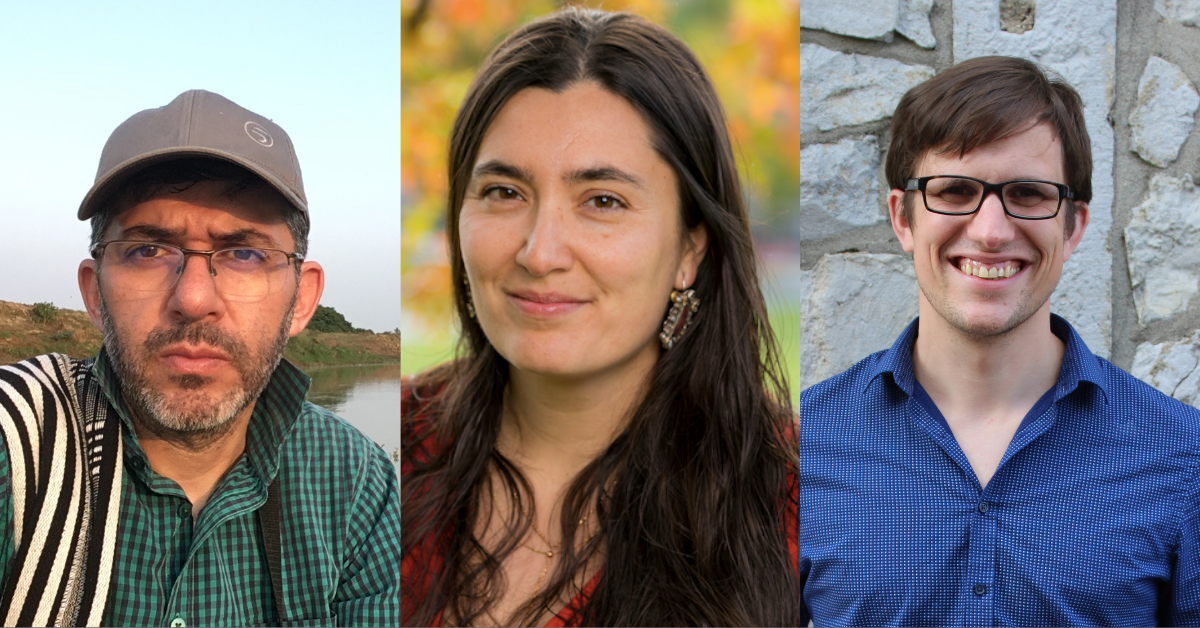
The multidisciplinary collection Amphibious Anthropologies: Living in Wet Environments brings together a global set of case studies, from Italy’s historic marshes to the tidal pools of the Bahamas, to show how living with unpredictable wetness has become crucial in the age of climate crisis. Editors Alejandro Camargo, Luisa Cortesi, and Franz Krause share more about the volume below.
First, can you describe how this book came to be and the process of putting it together?

This volume has been a long time in the making. In 2015, we were engaged in different panels at international conferences—the American Anthropological Association in Denver and the Nordic Geographers Meeting in Tallinn and Tartu—and decided to collaborate in publishing. The chapters that are now assembled in this book came from these panels, plus an open call for contributions. Both conference panels had proved that the topics of wet environments and amphibious lives were being discussed in multiple disciplinary contexts, from geography and anthropology to science and technology studies and political science. Yet at the time, we did not have a single volume providing an integrative approach to such environments. The open call allowed us to secure a diversity of approaches and places to produce a volume that could speak from and to different contexts.
In the process of developing a coherent collection, not only the editors but also the contributing authors read and commented on chapter drafts at various stages, which enabled a number of conversations throughout the volume beyond disciplinary boundaries. We’re very grateful to all of the authors who stuck with the publishing project through the entire process!
In the introduction to the collection, you note wetness as being a “third space beyond the opposition of land and water.” Can you share a few examples of how this understanding is central to the book?
The term third space generally describes phenomena that lie beyond apparent oppositions and that cannot be reduced to mixtures of the opposing fields. We use it to illustrate that wetness is not a mixture of water and land, or a zone where they meet, but an array of matter and meaning in its own right. In the Estonian Soomaa National Park (Soomaa translates as marshland), for example, various inhabitants, including small-scale farmers, tourism entrepreneurs, and ex-urbanite artists, all appreciate and struggle with wetness in their situated ways. This wetness cannot be adequately described as land with water in it, or water with land in it, but comes into being in very specific ways, for example as an obstacle to agricultural development, an indicator of an untamed natural landscape, or a unique selling point for a tourist destination. Wetness is therefore many things, but understanding it as a mix of water and land falls short of appreciating its role in society, culture, economics, and politics.
In what ways is this volume in conversation with other recent books on wetlands and fluvial environments, and what does it uniquely add to the discourse?
This book takes up many insights and inspirations from recent interdisciplinary work, including landscape architect Dilip Da Cunha’s book The Invention of Rivers, geographers Kuntala Lahiri-Dutt and Gopa Samanta’s study Dancing with the River, and anthropologist Caterina Scaramelli’s ethnography How to Make a Wetland. It also builds on older, largely forgotten work such as sociologist Orlando Fals-Borda’s book Historia Doble de la Costa. Building on these and other relevant works, and on the empirical research of the contributors, our volume considers the amphibious in a broader gamut of relations beyond the human, the hybrid, and the conceptual. It emphasizes interspecies and material-semiotic relationships in wet environments within their complex socio-ecological, temporal dynamics. In so doing, our conceptualization of the amphibious understands wet environments not as products of water and land but as differential configurations of the myriad of materials, relations, organisms, imaginations, and processes beyond water and land and their opposition.
Our collection provides interdisciplinary reflections from different continents and considers rivers, wetlands, sinkholes, lakes, and forests as diverse socio-ecological forms of the amphibious. In this way, our book is also a broader contribution to and will find readership in multispecies ethnography, posthumanism, new materialism, science and technology studies, human geography, and environmental anthropology. Thereby, we expect our book to be in conversation also with more recently published titles including Ned Randolph’s book Muddy Thinking in the Mississippi River Delta, Jim Scott’s In Praise of Floods, and Jason Cons’s Delta Futures.
What do you hope readers take away from the book?
We hope that readers will take away examples of ways of thinking and caring about wet environments that do not render them as marginal spaces in a terra-centric world. Rather, we seek to provide a multidisciplinary approach to wet environments as meaningful, fragile, and powerful places in a transforming world characterized by ongoing and sometimes catastrophic changes in amphibious ways of living together. We also expect readers to acquire new conceptual tools to critically approach the land-water binary and to imagine other ecologies and possibilities of inhabiting the earth.
What types of courses might this volume be used in and how?
Amphibious Anthropologies provides material for interdisciplinary courses both at the undergraduate and graduate level on general topics such as environment and society, human geography, environmental anthropology, natural resource management, environmental history, and environmental humanities as well as for more specialized subjects such as multispecies ethnography, contemporary materialisms, water and society, and vulnerability, risk, and adaptation.
While conceived of as a coherent volume, Amphibious Anthropologies offers the possibility of using each chapter as standalone material valuable for teaching. Its focus on specific regions of the world and distinct environments allows for flexible use, contributing to both geographically centered and thematically driven discussions. The introduction can also be used independently as a conceptual framework to problematize nature-society relationships.
Alejandro Camargo is assistant professor of environmental and Caribbean studies at the Universidad del Norte in Colombia. He is coeditor of Water Urbanization in Colombia. Luisa Cortesi is assistant professor of water, disasters, and environmental justice at the International Institute of Social Studies at Erasmus University. She is coeditor of Split Waters: The Idea of Water Conflicts. Franz Krause is professor of environmental anthropology and codirector of Multidisciplinary Environmental Studies in the Humanities at the University of Cologne. He is coeditor of Delta Worlds: Life Between Land and Water.
Related Books


