
The Emil and Kathleen Sick Series in Western History and Biography takes a broad and innovative approach to examining this field. Recent volumes have engaged with gender, race, labor radicalism, violence, environment, and political power, among other lenses of analysis, to tell new and provocative stories about this region. Volumes in the series also seek to be accessible to a more general audience, while making critical academic interventions that illuminate the rich diversity of ways we can understand our shared past of the North American West.
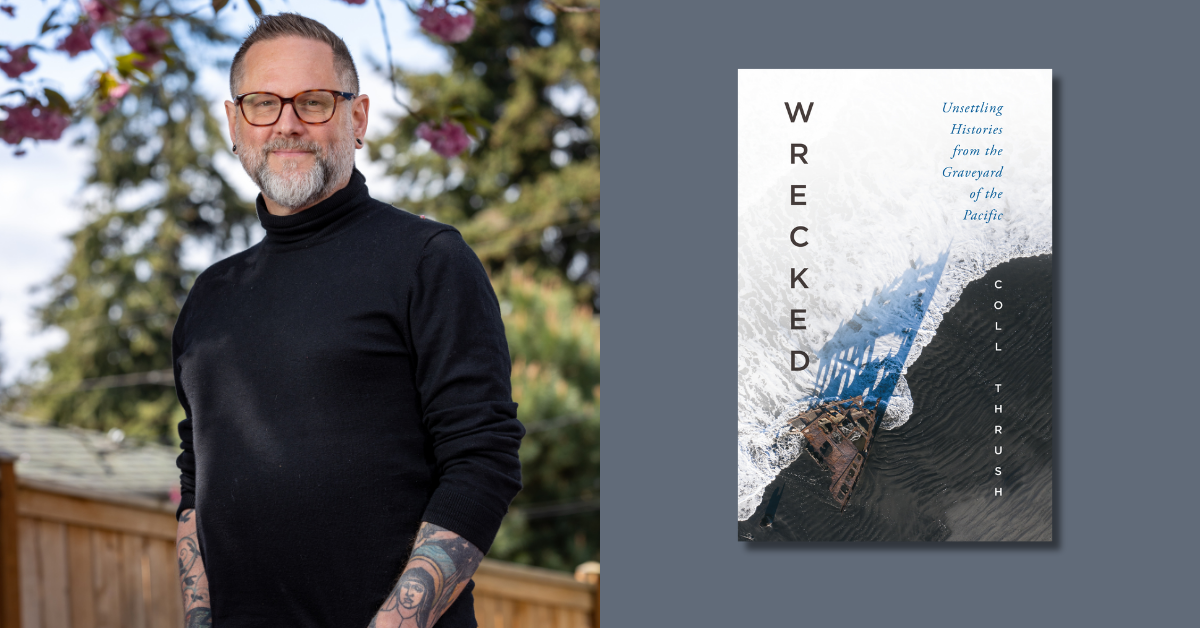
The Sick Series’ newest volume, Wrecked: Unsettling Histories from the Graveyard of the Pacific—written by Coll Thrush, the award-winning Northwest author and professor of history at the University of British Columbia—embodies this approach to Western history. In the hands of this master storyteller, accounts of shipwrecks puncture what we think we know about the past and its relevance today. Provocatively, Coll’s new book asks us to understand colonialism on the Northwest Coast not as a sweeping, triumphal narrative but rather as an example of continuing settler colonialism literally wrecking on Indigenous shores.
What follows is an edited set of answers to questions I recently posed to Coll.
—Joshua L. Reid
Joshua L. Reid: How is this book a different kind of maritime history? How does it broaden our sense of the North American West?
Coll Thrush: The funny thing, having written Wrecked, is that I’m not a maritime historian. Far from it. I came to this project as someone with expertise in thinking about historical relationships between Indigenous people and diverse newcomers and who is interested in considering questions of place and belonging. These were different approaches than those taken by the many people who had already written about the Graveyard of the Pacific for the last eighty or so years and who were focused on nautical history and maritime history proper. I’m very grateful for these earlier scholars’ work—Wrecked stands on their shoulders for sure—but I wanted to use the Graveyard’s history of maritime misfortune as a way to talk about regional pasts, presents, and futures more broadly. It turns out that shipwreck is a very good way to do that. Not only is it an iconic element of regional identity, but it serves as a powerful metaphor for the big stories of the Northwest Coast’s history.
All of us live in the debris of the past, which means we also have choices about how to move forward as a society, informed by our shared histories.
Coll Thrush
In terms of Western history more generally, I think Wrecked does three things. First, it brings the maritime world into conversation with the larger story of imperialism(s) in the North American West. Second, it is squarely centered on the coastal Northwest, a region that is often overshadowed by other Western places, and for which there is a much smaller body of scholarship despite the richness of the Northwest’s archives. Third, so much of the literature on the West focuses on westering, while Wrecked, instead, focuses on colonialism from the sea, moving in the other direction.
Reid: How does this book intersect with your previous publications, Native Seattle and Indigenous London?
Thrush: I think the parallels with Native Seattle are pretty self-evident: taking a place or topic that is well-known, placing Indigenous histories and the histories of colonialism at the center of the story, and thereby usefully disorienting the reader. Many of the practices and strategies I used in my first book—crafting thick descriptions of places as they are being transformed, emphasizing Indigenous persistence, and identifying the ways in which the past is still with us—are at play in Wrecked too. But in the years between Native Seattle and Wrecked, I spent a decade or so working with Indigenous histories at the so-called center of empire by following the journeys of Indigenous travelers (willing or otherwise) from territories that became the United States, Canada, Aotearoa New Zealand, and Australia. I’m not a British historian, either, so the learning curve was extremely steep, but I came away from Indigenous London with a much clearer sense of the larger patterns of British colonialism (which includes the United States) and a much stronger sense of global histories writ large. So when I returned to writing about this place—something I’d always intended to do—I found myself thinking differently about the ways in which the Northwest is bound up in vast networks of empire that stretch across the Pacific and beyond. Our part of the world seems bigger to me now than it did before.
Reid: Why is settler colonialism important to understand today?
Thrush: Because it’s ongoing. One of the main teachings of settler colonial studies is that colonialism is not an event that happened sometime in the past; rather, it is a set of powerful structures that continues to shape our lives today. We can see it, for example, in the struggle of Indigenous nations on both sides of the US-Canada border to assert their sovereignty in our present legal, cultural, and political contexts. We can also see it in the systemic racism that Indigenous peoples (and others) continue to face in the United States and Canada. I believe quite strongly that each of us has a responsibility to learn from and talk about these histories, because they shape our present in profound ways. That’s one of the major points I’ve tried to make with Wrecked: that all of us live in the debris of the past, which means we also have choices about how to move forward as a society, informed by our shared histories.

Reid: What do you hope readers get out of this book?
Thrush: On the most basic level, I hope that readers will recognize my love for this part of the world, and that perhaps the book will deepen their own relationships with the coast. Beyond that, one of my main goals is to have my audience (including, and perhaps especially, those outside the academic world) come to understand how the three prophecies of settler colonialism—that Indigenous peoples would disappear, that nature would be endlessly abundant and controllable, and that the past would stay past—have turned out to be false, and what the failures of those visions have meant for the diverse peoples who inhabit the region today. And lastly, I hope readers find in Wrecked compelling stories that pique their interest to learn more about the fascinating history of the coast and of the Pacific Northwest and British Columbia more generally. I’m a terrible regional chauvinist: this is one of the best places on Earth.

Coll Thrush is a professor of history at the University of British Columbia and founding co-editor of the Indigenous Confluences book series at the University of Washington Press. He is the author of Native Seattle: Histories from the Crossing-Over Place and Indigenous London: Native Travelers at the Heart of Empire.

Joshua L. Reid (citizen of the Snohomish Indian Nation) is an associate professor of American Indian Studies and the John Calhoun Smith Memorial Endowed Associate Professor of History at the University of Washington, where he directs the Center for the Study of the Pacific Northwest. His publications include The Sea Is My Country: The Maritime World of the Makahs.
More Books in the Emil and Kathleen Sick Series in Western History and Biography


