The annual Day of Remembrance commemorates the day in 1942 when President Franklin D. Roosevelt signed Executive Order 9066, the authorization leading to the mass incarceration of about 120,000 Japanese American citizens in concentration camps during World War II, without due process of law.
The history of Japanese American incarceration in the US serves as a powerful reminder of the dangers of racial prejudice and underscores the devastating impact of policies driven by fear and discrimination. In the context of today’s political climate, with increasing rhetoric surrounding national security and immigration, this history remains more relevant than ever.
The University of Washington Press is proud to be a leading publisher on Japanese American incarceration. Here, we’ve gathered some of the many books related to this history. We hope this list can be used as a reference for both readers and educators, and we encourage you to bookmark this post as we will continue to update it when new books are released.


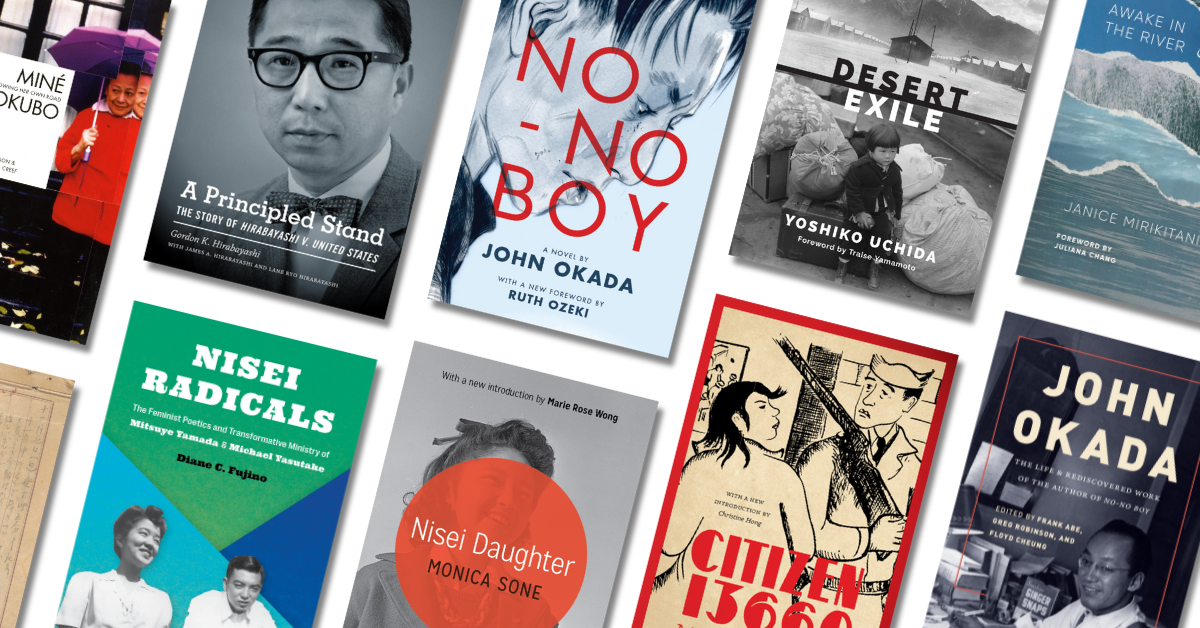
No-No Boy
by John Okada
“No-No Boy has the honor of being among the first of what has become an entire literary canon of Asian American literature,” writes novelist Ruth Ozeki in her foreword to the latest edition of this seminal text.
John Okada: The Life and Rediscovered Work of the Author of No-No Boy
edited by Frank Abe, Greg Robinson, and Floyd Cheung
An essential companion to No-No Boy, this compelling collection offers the first full-length examination of Okada’s development as an artist, placing his writing alongside essays that reassess his lasting legacy.
Nisei Daughter
by Monica Sone
A true classic of Asian American literature, Monica Sone’s autobiography offers an incisive account of her and her family’s experience being uprooted from their home and imprisoned in a “relocation” camp.
Desert Exile: The Uprooting of a Japanese American Family
by Yoshiko Uchida
An autobiographical account of life before and during World War II, this book relates the day-to-day experience of living in incarceration camps as well as the courage and strength displayed by those who were interned.


Citizen 13660
by Miné Okubo
Miné Okubo was a pioneering Nisei artist, writer, and social activist, and her unique account of life in incarceration camps in California and Utah illuminates this experience with poignant illustrations and witty, candid text—a forerunner to the modern graphic memoir. Read more about Okubo in Miné Okubo: Following Her Own Road edited by Greg Robinson and Elena Tajima Creef.
Enduring Conviction: Fred Korematsu and His Quest for Justice
by Lorraine K. Bannai
Fred Korematsu’s decision to resist President Roosevelt’s Executive Order 9066 led to his arrest and conviction of a federal crime before he was interned. Enduring Conviction tells this history and the inspiring story that followed, written by one of the attorneys who worked to overturn Korematsu’s conviction.
Exiled to Motown: A Community History of Japanese Americans in Detroit
by Scott Kurashige | Published by the Japanese American Citizens League Detroit
During World War II, Detroit emerged as a relative space of freedom for Nisei permitted by the War Relocation Authority to leave sites of incarceration but banned from returning to their homes in the exclusion zones. Drawing from a community-based oral history and archiving project, Exiled to Motown captures the compelling stories of Japanese Americans in the Midwest, filling in overlooked aspects of the Asian American experience.
Awake in the River and Shedding Silence
by Janice Mirikitani
Fierce, raw, and unapologetic, Janice Mirikitani’s poetry and prose are as vibrant and resonant today as when these two collections were first published in 1978 and 1987. Her writings confront sexualized violence, anti-Asian racism, the intergenerational trauma of incarceration, the dangers of passivity, and internalized oppression, while also illuminating the power of awakening from silence and fighting for justice.


Nisei Radicals: The Feminist Poetics and Transformative Ministry of Mitsuye Yamada and Michael Yasutake
by Diane C. Fujino
Weaving together the stories of two distinct but intrinsically connected political lives, this book examines siblings Mitsuye Yamada and Michael Yasutake and their half century of dedication to global movements, including multicultural feminism, Puerto Rican independence, Japanese American redress, Indigenous sovereignty, and more.
A Principled Stand: The Story of Hirabayashi v. United States
by Gordon K. Hirabayashi with James A. Hirabayashi and Lane Ryo Hirabayashi
In 1943, University of Washington student Gordon Hirabayashi defied the curfew and mass removal of Japanese Americans on the West Coast and was subsequently convicted and imprisoned. In A Principled Stand, Gordon’s brother James and nephew Lane bring together his prison diaries and voluminous wartime correspondence to take readers through the series of imprisonments and court battles Gordon endured.
Signs of Home: The Paintings and Wartime Diary of Kamekichi Tokita
by Barbara Johns
This beautiful and poignant biography of Issei artist Kamekichi Tokita uses his paintings and wartime diary to vividly illustrate the experiences, uncertainties, joys, and anxieties of Japanese Americans during the World War II incarceration and the more optimistic times that preceded it.
The Hope of Another Spring: Takuichi Fujii, Artist and Wartime Witness
by Barbara Johns
The Hope of Another Spring reveals the rare find of a large collection of art produced during World War II. The centerpiece of the collection is Fujii’s illustrated diary that historian Roger Daniels has called “the most remarkable document created by a Japanese American prisoner during the wartime incarceration.”
Unsung Great: Stories of Extraordinary Japanese Americans
by Greg Robinson
Drawn primarily from Robinson’s popular writings in the San Francisco newspaper Nichi Bei Weekly and community website Discover Nikkei, this collection offers entertaining and compelling stories that challenge one-dimensional views of Japanese Americans. The stories cover a wealth of themes, including mixed-race families, artistic pioneers, mass confinement, civil rights activism, and queer history.
Further Reading
And Justice for All: An Oral History of the Japanese American Detention Camps
by John Tateishi
Born in Seattle: The Campaign for Japanese American Redress
by Robert Sadamu Shimabukuro
Imprisoned Apart: The World War II Correspondence of an Issei Couple
by Louis Fiset
Japanese Americans: From Relocation to Redress
edited by Roger Daniels, Sandra C. Taylor and Harry H. L. Kitano
Judgment Without Trial: Japanese American Imprisonment During World War II
by Tetsuden Kashima
Letters from the 44nd: The World War II Correspondence of a Japanese American Medic
by Minoru Masuda
Personal Justice Denied: Report of the Commission on Wartime Relocation and Internment of Civilians
by Commission on Wartime Relocation and Internment of Civilians
Storied Lives: Japanese American Students and World War II
by Gary Y. Okihiro