
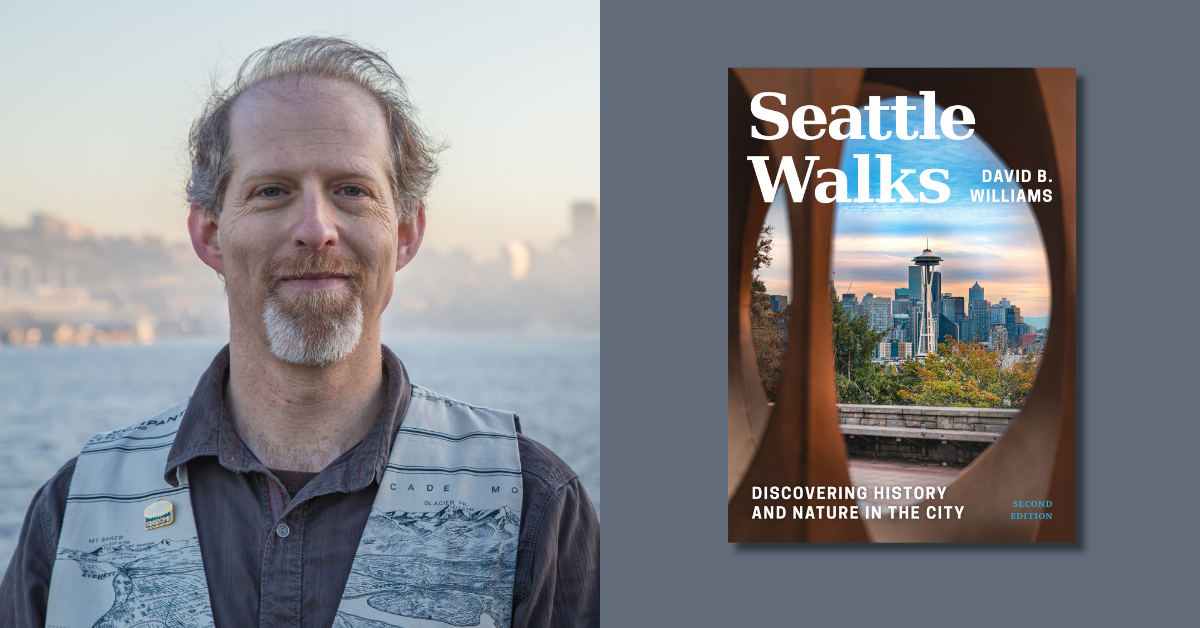
In the fall of 2023, Nicole Mitchell, the director of the University of Washington Press, contacted me about creating a new, updated edition of Seattle Walks. We had been talking about it on and off for several years—and going on walks together—so I knew I wanted to do it. Part of my impetus was that since the press published the first edition of Seattle Walks in 2017, the world has changed significantly.
During the Covid-19 pandemic, we were forced to stay home, or close to home, which led to many people discovering or rediscovering their own neighborhoods. People began to meet neighbors and the plants and animals that had coexisted with them. Many also began to seek out the human stories and to develop new connections with those who came before, not just previous denizens of recent decades but also those whose stories stretched back thousands of years, the Native inhabitants.

I was one of those people who spent far more time exploring Seattle than previously and who began to strengthen the connections I had made to place. Those many walks also increased my appreciation for the amazing cultural and natural history stories of Seattle. They crop up in so many places—from hidden gems, like the laundries of South Lake Union or synagogues converted to churches in the Central District, to ones I had long thought about but had not truly understood, such as the historic path of the Duwamish River.
With Nicole’s support and encouragement, I began to update Seattle Walks. I knew that I wanted to go to neighborhoods that hadn’t been included in the original, which motivated me to go out and explore, dive into the research, and ask friends to test the walks. All of this was fun and enlightening.
Not only have I incorporated new information in the walks but I have incorporated new ways of seeing the world and trying to be more inclusive. I ultimately added three new walks and removed two of the original seventeen. I decided to cut “Magnuson Park,” primarily because the redevelopment of the park has led so many people to discover it on their own, and “Where You At,” because it overlapped several other downtown walks. These walks will remain available on my website as PDFs.
The new walks cover some of the most historically diverse neighborhoods in Seattle: Cascade and South Lake Union, the Central District, and Georgetown. I am excited to add these and help share their stories with a wider audience.
Georgetown
Georgetown has a long history, in fact, the longest of any neighborhood in Seattle. Five months before the far better known Denny Party arrived, white settlers staked claims on land that would become Georgetown. Of course, they had long been preceded by the Native inhabitants, whose descendants continue to live here. They called themselves Duwamish, the people of the Duwamps River, an area rich in important plant and animal resources.

The earliest homesteaders soon gave way to people who took advantage of being separate from Seattle. Georgetown was scornfully dubbed “the cesspool of Seattle” with its horse racetrack, breweries, and saloons that featured gambling and prostitution. Like many smaller outlying communities, Georgetown was eventually annexed by Seattle, which resulted in less of a dire reputation. A bit over two miles in length, this walk explores the changing cultural and natural landscape of Georgetown.
Cascade and South Lake Union
For many recent arrivals in Seattle, the area south of Lake Union is synonymous with Amazon and tech workers, but the area’s stories and history go back thousands of years for Native residents. Initially hunters of post–Ice Age beasts such as mammoths, they later adapted to a diet of marine organisms and forest plants. The earliest homesteaders were Thomas Mercer and Louisa and David Denny. In 1872, Seattle’s first railroad carried coal from Lake Union to Elliott Bay, in what became known as the Cascade neighborhood.
Long an industrial neighborhood, it remained working class throughout the twentieth century and was home to immigrants from Scandinavia, Greece, Russia, and America’s own teeming East. Starting in the 1990s, Cascade became known as a hub for human health, technology, and life sciences. This two-mile tour winds through the neighborhood and past old laundries and churches and new buildings devoted to more twenty-first century activities associated with what has morphed into South Lake Union.
Central District
Located just east of downtown and formerly transected by the city’s historic street trolleys, the Central District is one of Seattle’s oldest neighborhoods. It has long been the center of Seattle’s vibrant Black community, which started to move into the area in 1882. It has also been home to other groups of people, including a thriving Jewish community of bakeries and kosher butchers, synagogues, and homes, as well as Japanese immigrants. Like the rest of the city, the Central District has long experienced economic and social change. For example, several Jewish synagogues were converted long ago to other purposes, and only small hints remain of the buildings’ pasts.
More recently, the area has experienced gentrification, which has brought many newcomers and led to the loss of some older businesses but has also resulted in new developments oriented toward strengthening the Central District’s still diverse arts, culture, social, and business communities. A little under 3.7 miles long, this walk weaves through this culturally rich area and emphasizes the complex social change that still influences residents.

I hope that all eighteen walks in my book will enable you to see Seattle in a new light and acquire a new appreciation for how the city has changed through time, how the past influences the present, and how nature is all around us, even in the urban landscape, which many people consider the least wild place around. And I trust that you will make many discoveries on your own.
Walking continues to be central to my life and a way to develop deeper connections to my home city, the place where I intend to reside for the rest of my life. I sincerely hope this new edition of Seattle Walks will bring you the same joy, sense of discovery, and deeper awareness of the complex history of the city as it has brought me.

David B. Williams is an author, naturalist, and tour guide. His many books include Homewaters: A Human and Natural History of Puget Sound; Too High and Too Steep: Reshaping Seattle’s Topography; Stories in Stone: Travels through Urban Geology; and, with Elizabeth A. Nesbitt, Spirit Whales and Sloth Tales: Fossils of Washington State. He writes about the human and natural world around Seattle and the Pacific Northwest in a free weekly newsletter, The Street Smart Naturalist.
More Books by David B. Williams


