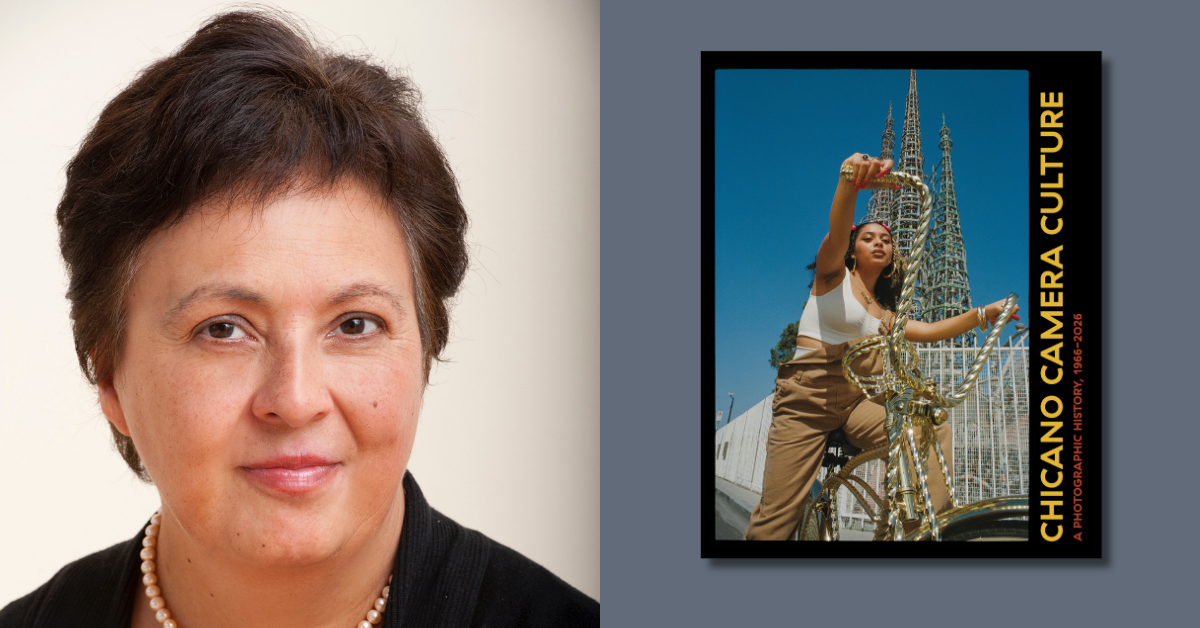
For decades, the contributions of Chicano photographers to American art history have been largely overlooked. Chicano Camera Culture: A Photographic History, 1966–2026—published to accompany a major exhibition at the Cheech Marin Center for Chicano Art & Culture (“The Cheech”) of the Riverside Art Museum—offers the first comprehensive survey of photography by Chicano artists based throughout the US. Editor and curator Elizabeth Ferrer, a leading scholar of Latinx photography, shares more about the project and its significance in the Q&A below.
What inspired you to take on such an expansive history, and why was now the right moment for this book and exhibition?

In 2020 the University of Washington Press published my book, Latinx Photography in the United States: A Visual History. Researching and writing this was a yearslong effort motivated by the fact that no such history existed. The contributions of Latinx artists to the history of photography in the United States were deeply unrecognized, and I aimed to rectify this omission. My goal was to then expand upon elements of this history.
In 2024 I curated a retrospective exhibition of the work of Louis Carlos Bernal (1941–1993), considered the “father of Chicano photography,” for the Center for Creative Photography at the University of Arizona. And while I had long believed that an exhibition surveying the entire history of Latinx photography was unfeasible, I decided that one focusing on the history of Chicano photography was not only possible, but necessary. This history begins with the rise of the Chicano civil rights movement in the mid 1960s, thus spans six decades—an ambitious but realistic time period to study.
Chicano photographers have had important stories to tell—about families, about cultural legacies that extend back to the pre-Hispanic era in the Americas, about histories that have been overlooked.
The timing was right for this project for a few reasons. First, my earlier work had laid a groundwork for a study of this scope. With Latinx Photography in the United States, I already had an outline of how I would approach the subject. The second reason has to do with the exhibition’s sponsoring institution, The Cheech Marin Center for Chicano Art & Culture of the Riverside Art Museum. When The Cheech, as it is known, opened in 2022, I was immediately interested in working with the museum. It is the first to be exclusively dedicated to Mexican American and Chicano art, and after seeing a few exhibitions there I knew it was the perfect venue for such a serious, large-scale exhibition. Thanks to support from the Luce Foundation, we were also able to publish the accompanying book. Both the exhibition and book represent the first effort at documenting the entire history of Chicano photography, beginning with the civil rights era. Finally, I’ll note that the time was right because the pioneering figures in this history are now all in their 80s, so it felt like high time. I have been honored to know them and to work with them in the realization of this exhibition and publication.
You write that Chicano photography is not a single style or movement but a “cultural ethos.” How would you define that ethos, and how does it manifest differently across generations of artists in the book?
This is always a complicated point for scholars and curators involved with Chicano or Latinx art. When artists are considered collectively, based on an aspect of their identity, are we assigning specific traits or characteristics to their art? In my mind, artists must be understood on their own terms, not with a preconceived set of notions. At the same time, as I delved into this history, I found that time and again Chicano photographers have a shared desire to use the camera as a tool for expressing the values, attitudes, and concerns that are common to Chicano people. So while these photographers take myriad approaches to the photographic medium, certain themes resonate throughout their work whether they were active in the 1970s or emerged more recently.

This ethos manifests quite differently across generations. For example, we can look at the theme of home and family. In the 1970s and ’80s, the aforementioned Louis Carlos Bernal portrayed Mexican Americans in the Southwest at home, surrounded by the family portraits, religious images, and objects that gave meaning to their lives. Moving into the 2000s, another photographer in the Southwest, Delilah Montoya (b. 1955), also depicted scenes of families at home but now, including DNA samples and migratory maps with her portraits to document the complex nature of mestizo (mixed) racial identity. And even more recently, the Los Angeles-based photographer Arlene Mejorado has expressed the ephemeral quality of home for migrant families. She has reproduced old family snapshots in large scale on banners that she hung in spaces that are part of her family history but that are no longer accessible to her. In doing so, she connotes the fragility of family legacies. Working with such disparate approaches, these as well as other photographers have continued to manifest the enduring value of family to Chicano life.
The early chapters trace photography’s roots in the Chicano civil rights movement. How did the camera function as both a political tool and a form of self-representation during that era?
The involvement of Chicanos with photography arose in parallel with the Chicano Civil Rights movement, when Mexican Americans in California and the Southwest engaged in a broad struggle for civil rights. It began in the Central Valley of California when Cesar Chavez and Dolores Huerta led a movement to unionize farmworkers, one that attracted legions of volunteers. The movement soon broadened to address other pressing issues among Chicanos. Mexican American high school students in Los Angeles staged school walkouts to protest the poor quality of the education they were receiving, and massive demonstrations against the Vietnam War also took place.

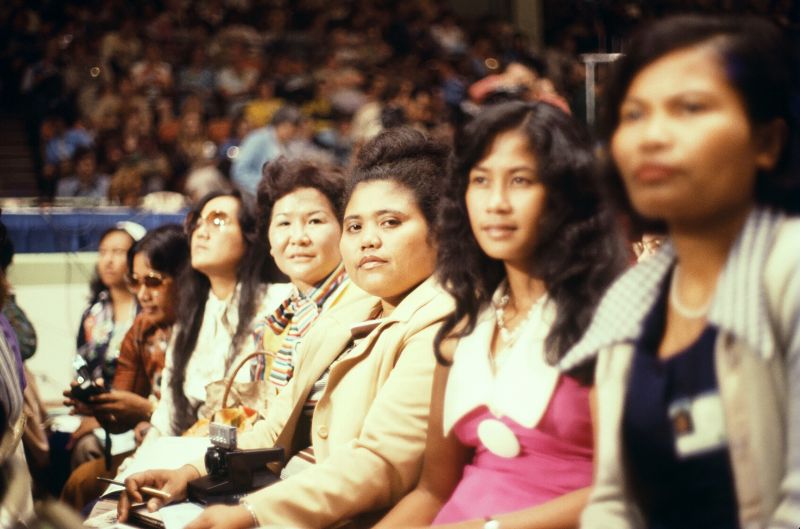
The activists involved with the movement included photographers—typically college students with minimal experience but armed with 35mm cameras and with a sense that they were witnesses to a pivotal moment in American history. Figures like Maria Varela (b. 1940), Oscar Castillo (b. 1945), George Rodriguez (b.1937), and Luis Garza (b. 1943) understood the consequential nature of what they were capturing: the rallies and marches, portraits of Chavez and other leaders, and expressions of a newfound cultural pride. But they were equally drawn to the everyday people they encountered along the way, and the photographs they made in the 1960s and ’70s represent the first of Chicano people by other Chicanos. Photography was an ideal tool for self-representation and for countering the derogatory images of Mexican Americans that circulated in the press in that era. These bodies of work laid a foundation for future generations of photographers who would devise new ways of reflecting on issues of identity, agency, and cultural autonomy.
Many artists in the book move beyond documentary into conceptual, staged, or digitally manipulated work. How do you see technical and aesthetic innovation shaping the evolution of Chicano camera culture over the past six decades?
This is another unrecognized fact about Chicano photographers; their significant contributions to advancing the medium aesthetically and technically. Chicano photographers have had important stories to tell—about families, about cultural legacies that extend back to the pre-Hispanic era in the Americas, about histories that have been overlooked. In the 1970s and ’80s, as photographers began to explore the creative potential of their medium, they devised distinct ways to craft an image, a message.
I hope that museumgoers and readers alike will appreciate the fact that Chicano photography constitutes a great, unrecognized aspect of our visual history—and by this, I mean American art history.
In the 1980s, for example, the San Antonio photographer Kathy Vargas (b. 1950), began assembling still lifes out of organic forms that she photographed in her studio and then layered into double exposures. She hand-painted the resulting prints to create poetic, symbolically charged images about memory and loss. Around the same time, Chicago photographer Robert Buitrón (b. 1953) was elaborately staging images for the camera. In one series, he portrayed the tragic Aztec lovers Popocatépetl and Iztaccíhuatl as new immigrants in the US, hapless yuppies who find themselves in incongruous, often comedic situations. In the following decade, Martina Lopez (b. 1962), who heads the photography department at Notre Dame University, became a pioneer in understanding the aesthetic potential of digital photography.

Later photographers devised rigorous conceptual means to examine the border and labor (Christina Fernandez, b. 1965), the little-known history of lynchings of Mexican Americans in California (Ken Gonzales-Day, b. 1964), and issues around displacement and gentrification (William Camargo, b.1989; Yulissa Mendoza, b. 1997). One of the first artists to deploy social media as a creative project is Guadalupe Rosales (b. 1980). Rosales is a gifted photographer in her own right, but her Instagram, Veteranas and Rucas, with over 270,000 followers, acts to underscore photography as a democratic medium. For me, the oeuvres of all these figures point to an undeniable fact: that Chicano photographers have contributed immeasurably to the advancement of the photographic medium.
You’ve long advocated for greater recognition of Latinx photography within American art history. What do you hope this exhibition and publication will change—within museums, scholarship, and the broader public understanding of American photography?
In terms of broader public understanding, especially with the exhibition, I hope Mexican American people who visit the Cheech (and they do, in great numbers) will feel recognized by the works in the exhibition. There will be portraits, places, and themes that will feel familiar, that will suggest that our ways of life are worthy of artistic presentation and memorialization. As with my previous projects, I hope that the academic community dedicated to Latinx culture and to photography find value in the publication. It is meant as a resource, as a foundational study on this topic. A few college professors have already told me that they plan to teach from the book, which includes essays by noted scholars. I also hope that museumgoers and readers alike will appreciate the fact that Chicano photography constitutes a great, unrecognized aspect of our visual history—and by this, I mean American art history. Many of these photographers, especially the historic ones, deserve a place in the canon. They deserve to have their work studied, collected, and deeply valued.
Chicano Camera Culture: A Photographic History, 1966 to 2026 will be on view at The Cheech through September 6, 2026, before embarking on a national tour.