
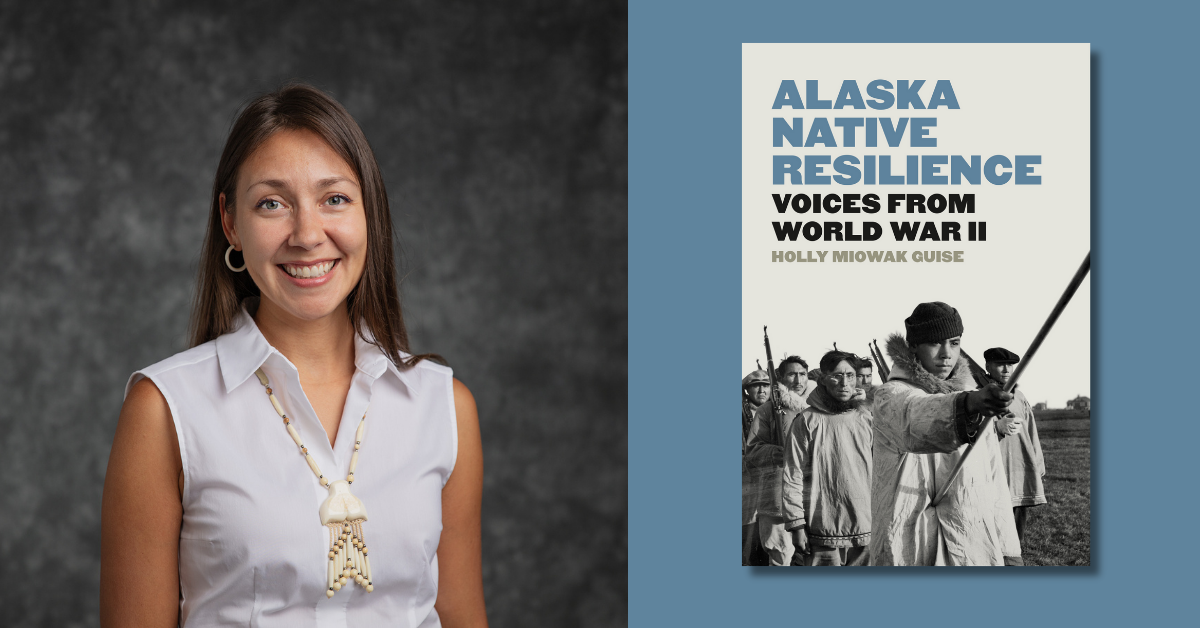
In Alaska Native Resilience: Voices from World War II, Holly Miowak Guise draws on a wealth of oral histories and interviews with Indigenous elders to explore the multidimensional relationship between Alaska Natives and the US military during the Pacific War. The forced relocation and internment of Unangax̂ in 1942 proved a harbinger of Indigenous loss and suffering in World War II Alaska. Violence against Native women, assimilation and Jim Crow segregation, and discrimination against Native servicemen followed the colonial blueprint. Yet Alaska Native peoples took steps to restore equilibrium to their lives by resisting violence and disrupting attempts at US control.
In the Q&A below, Guise shares more about her process of researching and writing the book as well as how Alaska Native peoples altered the colonial structures imposed upon them by maintaining Indigenous spaces and asserting sovereignty over their homelands.
First, can you touch on your background and what led you to this study?
I am enrolled Iñupiaq born and raised in Anchorage, Alaska. My family is from the village of Unalakleet. When I was growing up, I heard several stories from my grandparents about 1940s Alaska and assimilationist schools that punished my grandparents for speaking Iñupiat. I remember my grandpa Lowell Anagick talking about his time serving in the guerilla platoon known as the Alaska Territorial Guard with Muktuk Marston. I wanted to link these family histories to better understand the broader experiences of Alaska Natives during the war.
Can you share a bit about your process for conducting and compiling the oral histories of Alaska Native elders and veterans that are included throughout the book?
When I was an undergraduate majoring in Native American Studies at Stanford University, I began interviewing Alaska Native elders about racial segregation in the Alaska territory for my senior honors thesis. When I returned to oral histories as a graduate student at Yale University, I broadened the study. I wanted to better understand what was happening during the passage of the 1945 Alaska Equal Rights Act, which addressed racial segregation in Alaskan towns at businesses and public venues. This era included the Pacific War/World War II, Japan’s invasion of the Aleutian Islands, and settler colonial projects that developed alongside imperial US projects.
Over the years, I have worked with several tribal organizations, including the Aleutian Pribilof Islands Association, the First Alaskans Institute, the Sealaska Heritage Institute, and the Fairbanks Native Association Elder Program, as well as several other senior centers and community-based organizations, including the Alaska Veteran’s Museum, for conducting oral histories. I found tremendous help from Alaskan community leaders, libraries, museums, and through word of mouth in the Alaska Native community. I try to name every person and organization in a timeline of my oral history research travels in the appendix. Some of my favorite interviews are ones that I conducted with elders and their descendants. Oral history is indeed family history and academic.
As colonialism seeks to unravel Indigenous peoples and nations including through land removal, relocation, and boarding school separations, the act of Indigenous peoples restoring equilibrium goes directly against a colonial structure.
Holly Miowak Guise
What are some instances of separation, exclusion, and segregation in Alaska that readers might be surprised to learn?
In listening to elders, including my own grandparents, it seemed unfathomable that Western government, missionaries, and powers tried to assimilate Native children, an incredibly vulnerable population, all while social exclusion existed in Alaskan towns where white residents sought to establish settlements in the post Gold Rush era. How could Native children be forced to abandon their Native languages and assimilate to Westernization when Western society excluded and separated Native people?
Readers might also find it interesting to learn that in certain regions of Alaska, for example in the southeast, WWII–era military ordinances sought to separate Native women from servicemen to prevent interracial dating, sex, and marriage. Unsurprisingly, Tlingit activists mobilized through the Alaska Native Brotherhood and the Alaska Native Sisterhood, writing letters to government officials and military leaders to end stigmatization directed at Native women as venereal. As oral histories show, in some cases Native women defied the ordinances by simply dating and marrying servicemen anyway.


You write about what you call “equilibrium restoration.” Can you elaborate on this concept and share an example from the book?
It is probably common for writers to be unable to sleep, or to think deeply in the middle of the night. One such night, I thought about Alice Petrivelli’s story about her uncle banishing the Bureau of Indian Affairs (BIA) doctor, H.O.K. Bauer, who brought physical harm, death by neglecting a patient, and sexual violence to the Atkan wartime relocation camp in southeast Alaska. I thought about the action of her uncle banishing the doctor, essentially expelling federal “aid,” and I realized he was trying to restore equilibrium for their people.
Conceptually, I found “equilibrium restoration” in a variety of settings where Alaska Native people resisted, expelled, and sometimes even appropriated or adopted colonial structures to maintain indigenization. As colonialism seeks to unravel Indigenous peoples and nations including through land removal, relocation, and boarding school separations, the act of Indigenous peoples restoring equilibrium goes directly against a colonial structure. Throughout the book, I try to show different ways that Alaska Natives restored equilibrium, sometimes through tribal mutual aid from Tlingit to relocated Unangax̂ during the war, which counteracted US colonial structures.
For Alice’s uncle, equilibrium restoration could be suddenly achieved in banishing the BIA physician. For others, like elder Nick Alokli from Kodiak, equilibrium restoration took his lifetime. The Western school teachers punished Nick as a child by slapping him with the straps from hip boots for speaking Sugpiaq, and yet, as an elder he returned to Sugpiaq by teaching it to the future generation of youth. He participated in the project of restoring his Indigenous language that colonialism sought to annihilate.
How has this colonial history manifested in Alaska Native communities today?
This is both an easy and hard question to answer. For those impacted by colonialism— through language theft, removal, family separations, sexual violence, and more—these dark histories impact individuals, families, communities, tribal nations, and the intricacies of daily life. These darker colonial histories can be felt, carried, and—I am going to be a bit more hopeful here and say—expelled over one’s lifetime or generations. Native people continue to try to unravel the harm of colonialism while reinstating their Indigenized nations, spaces, and livelihoods.

What do you hope readers take away from your book?
My main goal for this book is to center the voices, stories, and reflections of Alaska Native elders who witnessed settler colonialism alongside militarization during World War II. Elders shared an array of experiences depending on their tribal geography, gender, and their age at the time of war. I find it profound that so many elders (more than 90 from this study) challenged settler colonialism and discrimination and navigated the war all while clinging to their Indigenous identities and sovereignty. I tried to highlight background information about each elder quoted in the book so readers can better understand Indigenous perspectives. I wish readers will see how much care goes into oral history in building relationships with elders over time and connecting elders through resources by academic institutions as well as tribal and community-based organizations.
Holly Miowak Guise (Iñupiaq) is assistant professor of history at the University of New Mexico. She is the creator of World War II Alaska, a digital humanities project that centers the voices of Alaska Native elders and veterans by bridging institutional, federal and university archives, tribal archives, and oral histories.
Related Books


