
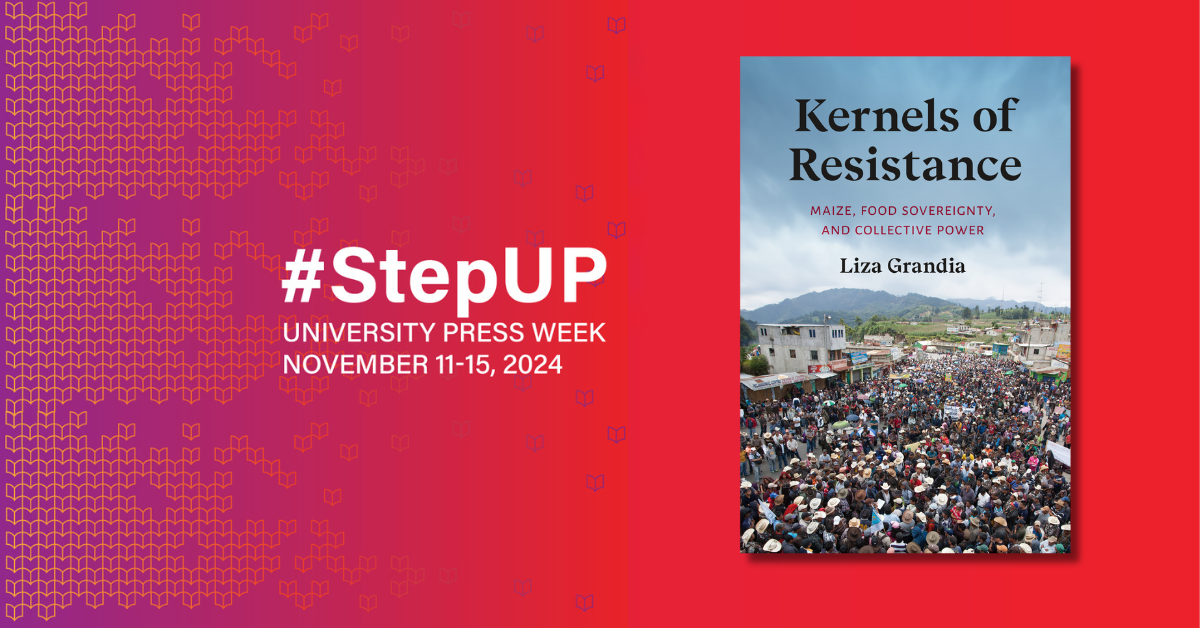
Happy University Week! The University of Washington Press joins the Association of University Presses (AUPresses), our university press colleagues, and readers around the globe to celebrate and raise awareness of the vital work that university presses do every day. This year’s theme, #StepUP, highlights how university presses worldwide step up to educate and enlighten, motivate and inspire, support and act.
As part of the AUPresses UP Week Blog Tour and today’s prompt—Who StepsUP at your press?—we are featuring an excerpt from Kernels of Resistance: Maize, Food Sovereignty, and Collective Power by Liza Grandia, forthcoming in January.
Drawing from decades of participatory research, Grandia chronicles how Mesoamerican food activists faced down Monsanto . . . and won.

It was February 17, 2004, 11 Tz’i’, or 12.19.11.0.10, a day in the Maya calendar symbolizing justice, law, spiritual authority, and the balance between individual and collective good. Don Pablo B’otz was one of the most joyful and gentle souls I had the privilege to meet during my years living in Q’eqchi’ Maya territory. Born in Guatemala, he fled the civil war for refuge across the border to Jaguarwood village in southern Belize.1
We met because an Indigenous nonprofit had enlisted me to film and document the elders’ traditional ecological knowledge in the Sarstoon-Temash watershed in order to support a Maya constitutional claim for territorial autonomy and community comanagement of a national park. In a meeting during which the Q’eqchi’ elders defined the terms of my research, Don Pablo had volunteered to demonstrate traditional candlemaking using forest-harvested wax from wild, endemic Melipona bees.
On the scheduled day (11 Tz’i’), I arrived at his house by dawn, but he was running late following a 3:00 a.m. community pig slaughter. His wife wanted to harvest some slow-growing tapikal beans, so when Don Pablo arrived back home at 6:20 a.m., we changed plans to visit his milpa (the traditional term for a polycropped maize field). Like a proverbial trip to grandmother’s house, we went over the river in a borrowed dugout canoe and through the woods, then walked another four kilometers to reach a mosaic of connected plots that he and seven close friends and compadres had slashed, burned, and helped one another plant.
To adapt a line from the musical Oklahoma!, the maize in Don Pablo’s field was as high as a jaguar’s eye. When I queried how much he had planted, Don Pablo responded not in acres or workdays, but with the traditional metric of the number of sown maize cobs: one hundred for the wet season and three hundred for the dry season. His agrodiverse milpa involved far more than the proverbial “three sisters” companion planting of maize, nitrogen-fixing beans that trellis up the stalk and fertilize the maize naturally, and squash as a ground cover that naturally suppresses weeds.

Don Pablo began by pulling some onions to use in cooking the pork soup planned for lunch, remarking that he would leave the rest to go to seed when the field was fallowed. He checked his rice sprouts and dug up a few sweet potatoes (ix) and macal roots (ox) that had been planted while offering special prayers he had learned from an elder, who had learned them from an elder before him, and so on, rearward for millennia. His chili peppers were ripening, and I spotted pineapples in another corner near a patch of ub’el (or Santa María, in Spanish).
To an outsider these greens might look like weeds. However, Don Pablo explained that some folks like to eat them boiled or sautéed, but his family mostly used them to wrap fish from the river or snails from the creek before roasting. Because I was running a fever, we chatted about some other medicinal plants growing in his milpa. At the forest’s edge we collected vines for making a wheel to dip the natural beeswax candles that would provide light during his all-night vigil before planting to accompany the soul (xmuhel) of his maize seeds.
A north wind rustled through the maize, as if whispering the secrets of the ancestors. That season Don Pablo had only planted white maize, but in the past he had planted other maize colors. Gesturing to his forearms, head, and belly, Don Pablo explained that his people were made from maize. In fact, the five colors of maize “are like our bodies—red for blood, yellow for skin, white for bones, blue-black for hair, and green for the skyearth.”2 His somatic description of being made from the flesh of maize echoes a classic Maya tale recorded in the sixteenth-century sacred text, the Popol Vuh. Central to pan-Maya identity, this creation story was kept alive in many different languages through oral histories passed down over generations of people living in even the most remote rainforest villages, like Jaguarwood. Over the next two months that I lived in Jaguarwood, other elders shared stories of how maize colors came from Paxil, a sacred mountain. They also explained the tradition of planting three kernels in every hole: one for the mountain gods, one for the animals or bugs, and one for themselves. This triad is a gesture to abundance and plenty for all, and of farming with nature rather than against it.
Weighed down with full sacks of bounty, we merrily headed home. After leaving the lushness of Don Pablo’s complex multicropped and organic milpa, we passed through an adjacent monocropped field that had been blitzed with paraquat, a highly toxic herbicide now banned in almost sixty countries.3 A strange, slippery fungus was growing on the barren earth between the maize stalks. “How foolish [my son] is,” Don Pablo lamented. “He could have planted so many good foods.” Encouraged by foreign missionaries to use Western inputs, Don Pablo’s son had begun to reject the old ways after he married a Baptist girl and converted to Protestantism. Don Pablo explained that his son was also “a little lazy” and wanted to save time by spraying herbicides instead of weeding by machete. I correctly surmised that his son’s field was planted with store-bought hybrid seeds because it was already pollinating. This set the stage for the first conversation I had in Q’eqchi’ about GMOs, or iyaj jalb’il xyuam rik’in b’an (roughly, seeds whose life is changed with chemicals).

Many elements of that memorable visit to Don Pablo’s milpa—the Melipona bees, the sacrilege of crop contamination, the erosion of agrodiversity, and the nutritional and medicinal value of “weeds”—became universal themes of resistance to genetically modified (GM) corn throughout Mesoamerica.
Although Belize quickly decided to prohibit GM crops in 2011, they had been legal for a brief time. Like its neighboring countries, Belize imports a significant quantity of GM corn from the United States. It is possible that Don Pablo’s native maize had already been contaminated with transgenic splices. With corn pollen able to travel up to half a mile, just one flowering GM stalk in a gust of wind could contaminate dozens of adjacent milpas.
That is the essence of the “milperos’ dilemma”: how to defend their sacred maize against an invisible technological threat in a world of interconnected trade and corporate aggression. The kernels of Mesoamerican resistance to GM corn provide counterpoints to the individualistic, consumer-driven, and parochial food politics that have taken hold in the US. Consumer politics end at the cash register, but collective Mesoamerican resistance to GMOs has germinated broader—even state-sponsored—support for reviving agroecological practices that can repair the damages of industrial agriculture.

The methods and processes by which Mexican and Guatemalan social movements won their struggles against GM corn also teach deeper lessons of diversity and plurality. In Mexico, members of a motley movement to defend maize are now in high positions of state leadership, designing strategies to reinvigorate milpa systems and support a national glyphosate detox. In Guatemala, renewed civic confidence after the defeat of the first Monsanto Law germinated a generalized defiance against corruption and seeded a new political movement, the Movimiento Semilla, literally the “Seed” party, which won the presidency in 2023 in a surprise landslide.
To defend those election results and prevent a second Monsanto Law from slipping through the outgoing Congress, Indigenous ancestral authorities used roadblocks to paralyze the country for more than a month and maintained a peaceful encampment in the capital for 105 days straight (a number with deep calendrical meaning), from October 2, 2023, to the delayed presidential inauguration held on January 14, 2024.
A fortnight after this democratic transition, a Poqomam (Maya) congresswoman introduced legislative bill no. 6086 to protect both biodiversity and collective ancestral knowledge from privatization. Five hundred years after Pedro Alvarado brutally invaded the region that became Guatemala, Maya peoples are redefining their nation according to principals of dignity and plurality, or, as the Maya Zapatistas in Mexico would say, “a world where many worlds fit” (un mundo donde quepan muchos mundos).
The aim of my book, therefore, is simple: by sharing how the People of Maize defeated one of the world’s largest and most reviled corporations and planted renewed seeds of democracy, I hope to reinvigorate the political hopes and aspirations of we, the People of High-Fructose Corn Syrup, to demand greater collective regulatory protections, stand up to the corporate interests bullying our Mesoamerican neighbors, and codevelop agroecological pathways to more climate-wise forms of agriculture.
Excerpted and adapted from Kernels of Resistance: Maize, Food Sovereignty, and Collective Power. This book is freely available in an open access edition thanks to the generous support of the UC Davis Library at the University of California, Davis.
Notes
- B’otz left Guatemala ostensibly to cure his late first wife’s illness with the help of a Belizean healer, but reading between the lines of his varying migration stories, it is clear he fled Guatemala’s military repression during the civil war. ↩︎
- In Q’eqchi’, fresh maize-on-the-cob is called rax hal, or “green” corn. ↩︎
- Evans and Glass, “Why California Must End the Must End the Use of Herbicide Linked to Cancer, Parkinson’s,” Cal Matters, November 22, 2022.” ↩︎

Liza Grandia is a cultural anthropologist, professor, and chair of the Native American Studies Department at the University of California, Davis. Her first book was Enclosed: Conservation, Cattle, and Commerce among the Q’eqchi’ Maya Lowlanders.
About the UP Week Blog Tour
Every day this week, participating presses will be blogging about the many ways in which university presses step up. Check out more posts from the UP Week Blog Tour and join on social media with the #UPWeek and #StepUP hashtags.


One response to “University Press Week: Liza Grandia, author of “Kernels of Resistance,” on Mesoamerican Food Activists”
[…] these challenging times. Follow the University Press Week blog tour at University of Alberta Press, University of Washington Press, NYU Press, Temple University Press, Wilfrid Laurier Press, University of Nebraska Press, Yale […]