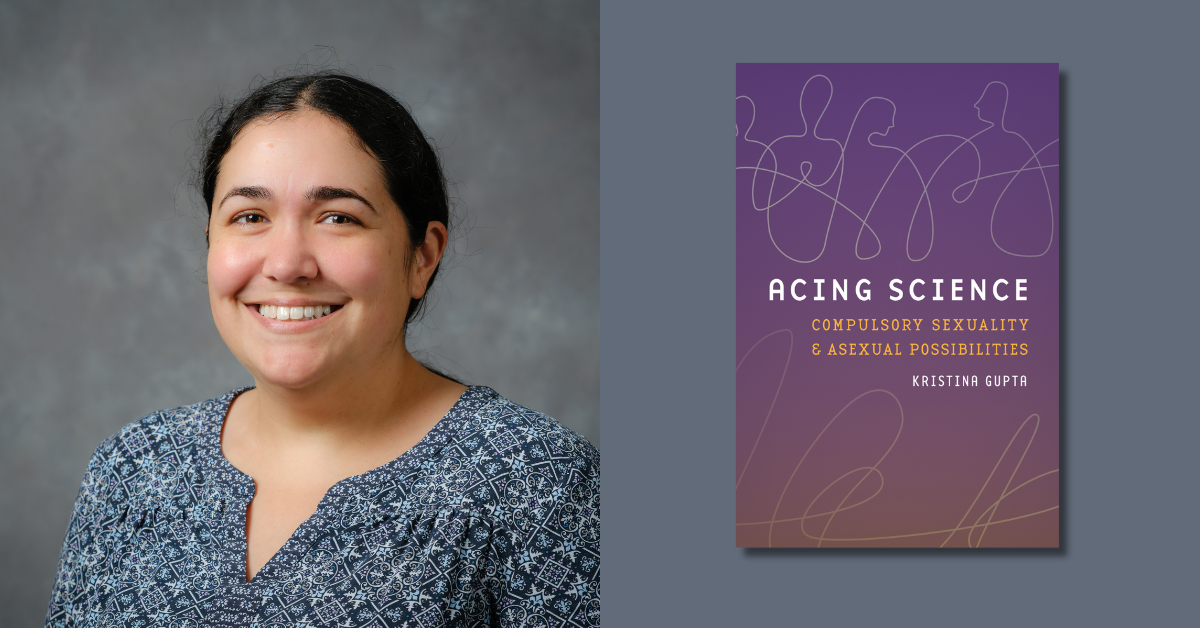
Sexual desire is often treated as a given—something everyone has and should have. Compulsory sexuality operates as a largely unexamined premise, shaping not only popular culture but scientific research. In Acing Science: Compulsory Sexuality and Asexual Possibilities, author Kristina Gupta reveals the limits and exclusions of defining desire as universal. She argues that by framing sexual desire as socially necessary, scientific studies render asexuality invisible or suspect.
Here, Gupta shares more about the scientific discourses that lead to the erasure of asexuality (ace), as well as the path toward a more ace-positive world.
In the book, you analyze a wide range of scientific sites—from diagnostic categories of “sexual disinterest” to neuroimaging studies and animal research. What patterns did you notice?
Across these seemingly different areas, much scientific research supports compulsory sexuality by treating sexual desire as an innate, universal drive and by treating the absence of sexual desire as a sign of illness or dysfunction. Sexual desire and sexuality are also often seen as serving some important social function, for example, they may be seen as necessary to maintain romantic relationships, which in turn are seen as fundamental building blocks of society.

At the same time, much scientific research can be read “against the grain” to reveal that concepts like sexual desire, sexual behavior, and sexual pleasure are not coherent categories, either in the scientific research itself or in the material world science seeks to represent. In turn, recognizing the incoherence of these categories can create space for us to think otherwise about our desires, pleasures, activities, and relationships outside of narrow sexual frames.
As you point out, much of scientific research treats sexual desire as universal. How does this idea shape the way people who don’t experience desire in expected ways are understood or treated?
If sexual desire is seen as an innate, universal drive, then the absence of sexual desire tends to be viewed as a deficit, dysfunction, or illness. This understanding of sexual desire leads to a view of asexual (ace) people as disordered or as mistaken about or repressing their own sexual desires.
Most of us have learned the lessons taught by compulsory sexuality—namely, that it is healthy and normal to experience sexual attraction, that sexual/romantic relationships are necessarily the most important relationships in our lives, and that if we are not interested in sex or are not having “enough” sex, there is something wrong with us and our lives are less fulfilling.
As discussed in chapter 1 of the book, at various points since at least the late nineteenth century, “sexual disinterest” has been defined as a disorder in medical discourses in Europe and the United States. People who have been diagnosed with a desire disorder have been “treated” with a wide range of medical interventions, from talk therapy to medication. This trend continues in the present; for example, desire disorders remain in the current edition of the American Psychiatric Association’s Diagnostic and Statistical Manual of Mental Disorders (DSM-5).
You show that scientific ideas about sexuality don’t exist in isolation but are shaped by broader systems like sexism, racism, ableism, and heteronormativity. Can you share an example of how these forces show up in the ways sexuality is studied and explained?
Scientific ideas about sexuality intersect with ideas about gender, race, ability, nation, and other categories. For example, in the contemporary era, “sexual disinterest” is most associated with white women, as current racialized and gendered sexual stereotypes position white women as sexually passive and “less sexual” than white men or people of color. This association is illustrated in scientific research by the fact that participants in recent clinical trials of pharmaceutical treatments for “female sexual dysfunction” were overwhelmingly white women.
As another example, most of the neuroimaging research on “sexual response” has been conducted with white male participants, and yet scientists argue that they have identified a “universal” brain sexual response system based on this research. This belief is in part enabled by the fact that “maleness” and “whiteness” are seen as stand-ins for the universal, thus research primarily conducted on white male participants is used to produce theories about a universal brain sexual response system.
If we can recognize that the distinction between sexual pleasure and other types of pleasure, for example, is at least in part a socially constructed difference, then we might think differently about our own experiences of pleasure.
Your work rereads scientific research to “denaturalize” concepts like sexual desire and pleasure. What does this denaturalization make possible, both intellectually and politically?
Our society tends to view sexual desire and sexual pleasure as clearly different from (and often more important than) other forms of desire and pleasure. If we can recognize that the distinction between sexual pleasure and other types of pleasure, for example, is at least in part a socially constructed difference, then we might think differently about our own experiences of pleasure. Rather than focusing on how much sex or how many orgasms we are having, we might instead focus on whether we are satisfied with the quantity, quality, and diversity of pleasurable experiences in our lives. Rather than automatically assuming that romantic/sexual relationships are the most important relationships in our lives, we might instead value a broader range of relationships, including friend and kin relationships that may or may not involve sex. I believe this different way of thinking would support a more ace-positive world, as asexuality would emerge not as a deficit but a different prioritization of certain desires, relationships, activities, and pleasures.
What do you hope readers take away from the book when thinking about their own desires, relationships, and assumptions about sexuality?
Most of us have learned the lessons taught by compulsory sexuality—namely, that it is healthy and normal to experience sexual attraction, that sexual/romantic relationships are necessarily the most important relationships in our lives, and that if we are not interested in sex or are not having “enough” sex, there is something wrong with us and our lives are less fulfilling. I hope that the book will encourage readers to question these assumptions and that readers will come away from the book less concerned about whether they or others experience the “right” level of sexual attraction or engage in the “right” amount of sexual activity, as fulfilling relationships and fulfilling lives may include sexuality or they may not.

Kristina Gupta is associate professor of women’s, gender, and sexuality studies at Wake Forest University. She is author of Medical Entanglements: Rethinking Feminist Debates about Healthcare and coeditor of Queer Feminist Science Studies: A Reader.
Further Reading in the Feminist Technosciences Series